High airborne microbial counts, recurring mold growth, and unexpectedly shortened product shelf life often point to the same underlying problem: inadequate environmental hygiene control.
In food processing facilities, air can become an important pathway for microorganisms to spread, especially in areas where products are exposed during cooling, filling, handling, or packaging.
Effective air hygiene management is therefore not simply about installing an air disinfection device. It requires a systematic approach that combines environmental monitoring, ventilation management, filtration, humidity control, cleaning and disinfection, and continuous verification.
This guide outlines a practical approach for food manufacturers looking to strengthen airborne microbial control in high-hygiene production areas.
1. Why Do Airborne Microbial Levels Increase?
Airborne microorganisms can enter and spread through a food production environment in many ways. Common causes include:
1. Poor Airflow Management
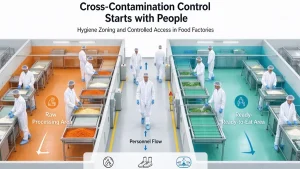
Improper airflow patterns can move air from lower-hygiene areas toward higher-hygiene production zones, increasing the risk of cross-contamination.
Air movement should be carefully designed according to the production process and hygiene zoning.
2. Poor Maintenance of HVAC and Filtration Systems
Air filters that are not cleaned or replaced on schedule can accumulate dust and organic particles.
Over time, poorly maintained filters, cooling coils, drain pans, ducts, and other HVAC components may become potential sources of microbial contamination.
Regular inspection, cleaning, filter replacement, and maintenance records are therefore essential.
3. Temperature and Humidity Problems
High humidity and temperature fluctuations can create favorable conditions for microbial growth.
Condensation is particularly problematic in cooling rooms, packaging areas, and other temperature-controlled environments. Moisture on ceilings, walls, equipment, or ventilation components can contribute to mold and microbial growth.
4. Inadequate or Inconsistent Disinfection
Relying on a single disinfection method may leave gaps in environmental control.
For example, traditional UV lamps may have limited coverage because UV light does not easily reach shadowed areas. At the same time, disinfection frequency and operating conditions may not always match the actual contamination risk.
Most importantly, disinfection should be verified through environmental monitoring, rather than assumed to be effective.
2. A Systematic Approach to Air Hygiene Management
A reliable air hygiene program should follow a continuous cycle:
Monitor → Identify → Control → Verify → Improve
Step 1: Establish an Environmental Monitoring Program
Environmental monitoring helps food manufacturers understand whether their hygiene controls are working effectively.
Depending on the product and production environment, monitoring may include:
| Monitoring Element | Recommended Practice |
|---|---|
| Sampling Locations | Focus on areas close to exposed products, product-contact surfaces, cooling areas, filling points, and internal packaging zones |
| Monitoring Indicators | Aerobic microbial counts, yeast and mold, or other relevant environmental indicators based on product risk |
| Monitoring Frequency | Establish a risk-based schedule and increase frequency when abnormal trends are identified |
| Evaluation | Use historical data and internal limits to identify trends and potential loss of control |
| Corrective Action | Investigate the root cause, implement corrective measures, and verify the effectiveness of the actions |
Monitoring locations should be selected based on the risk of product contamination, rather than simply distributing sampling points evenly throughout the facility.
3. Improve Ventilation and Air Filtration
Good ventilation design is one of the foundations of environmental hygiene.
Food processing facilities should consider:
- Maintaining appropriate airflow direction between different hygiene zones
- Preventing air from contaminated or low-hygiene areas from entering high-hygiene production areas
- Maintaining appropriate pressure relationships between hygiene zones where required
- Locating air intakes away from potential contamination sources
- Using appropriate filtration based on the hygiene requirements of each production area
- Establishing a preventive maintenance schedule for filters and HVAC components
- Regularly cleaning supply air diffusers, return air grilles, and other accessible components
- Inspecting ventilation systems for dust accumulation, moisture, condensation, and microbial growth
The goal is not simply to move more air, but to control where the air comes from, where it goes, and what it carries.
4. Build a Practical Air Disinfection Strategy
Air disinfection can be used as an additional control measure in areas where airborne contamination presents a significant risk.
A practical approach is to combine different disinfection methods according to operating conditions.
| Production Stage | Recommended Approach | Typical Application |
|---|---|---|
| During Production | Recirculating UV air disinfection | Continuous microbial reduction while employees are working |
| After Production | Controlled ozone treatment in unoccupied areas | Whole-room environmental disinfection |
UV Air Disinfection During Production
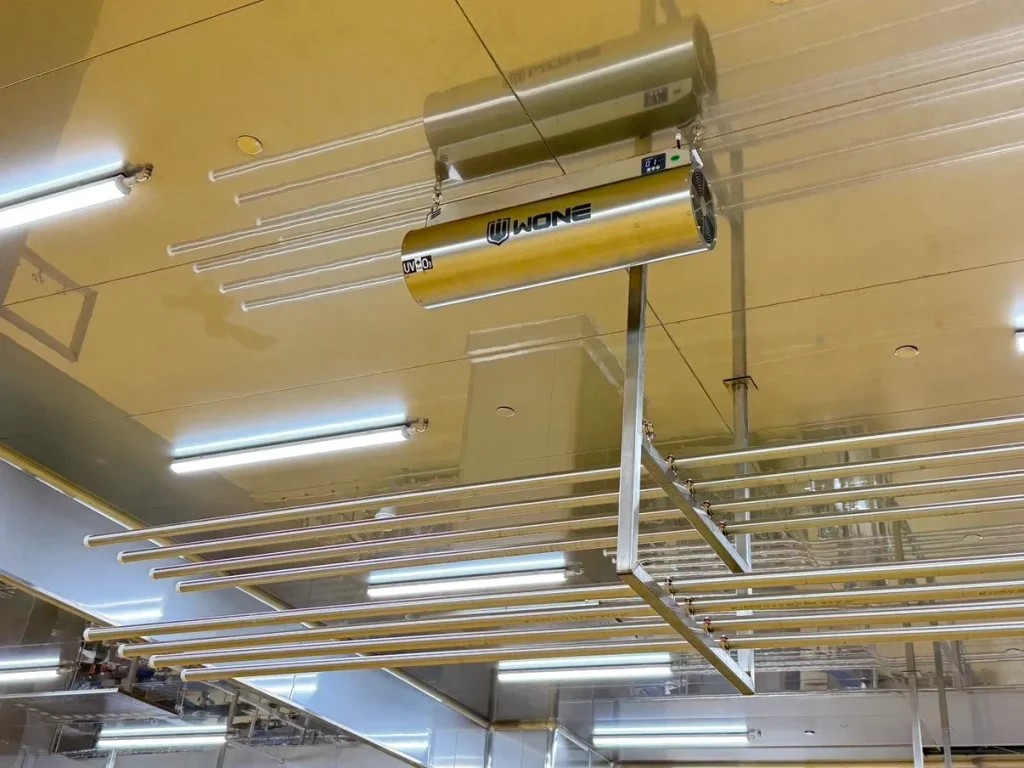
A recirculating air disinfection unit continuously draws room air into the equipment.
Inside the enclosed disinfection chamber, high-intensity UV light treats the air before returning it to the production environment.
Because the UV source is enclosed inside the equipment, the system can be designed for use during occupied production periods without exposing workers directly to UV radiation.
This makes it suitable for areas where continuous air hygiene control is required.
Ozone Disinfection After Production
Ozone can be used as an additional environmental disinfection method when the production area is unoccupied.
Because ozone can disperse throughout a room, it can reach areas that may be difficult to treat using direct-contact or line-of-sight methods.
However, ozone treatment must be carefully controlled. The area should be unoccupied during treatment, and appropriate safety procedures, concentration control, exposure time, and ventilation must be established before personnel re-enter the area.
5. Verify Disinfection Performance
Installing an air disinfection system does not automatically guarantee effective microbial control.
The effectiveness of the overall hygiene program should be verified through regular environmental monitoring.
A practical verification process can include:
Before disinfection → Disinfection → After disinfection → Compare results → Adjust
If microbial levels remain elevated, investigate potential causes such as:
- UV lamp performance and operating hours
- Airflow and air exchange conditions
- Ozone generation and treatment parameters
- Temperature and relative humidity
- Filter condition
- Condensation and moisture
- Cleaning effectiveness
- Organic contamination
- Equipment positioning and coverage
- Employee practices and hygiene procedures
The objective is to identify the root cause, rather than simply increasing the disinfection time.
6. A Dual-Mode Solution for Food Processing Air Hygiene
For food manufacturers looking for an additional layer of environmental control, a dual-mode air disinfection system can combine UV air treatment during production with ozone treatment after production.
UV Mode — During Production
- Continuous air circulation and treatment
- Suitable for occupied production areas
- Helps reduce airborne microbial load
- Enclosed UV chamber minimizes direct UV exposure
- Suitable for high-hygiene production environments
Ozone Mode — After Production
- Designed for unoccupied areas
- Helps provide broader environmental treatment
- Can reach areas that are difficult to treat with direct UV exposure
- Can also help reduce unwanted odors
- Treatment parameters can be adjusted according to room size and application requirements
Smart and Convenient Operation
A modern air disinfection system can also simplify daily hygiene management through features such as:
- Scheduled operation
- Remote control
- Automatic operating cycles
- UV operating-time tracking
- Easy maintenance management
- Flexible day/night operation
This allows the air hygiene program to become part of the facility’s routine preventive hygiene system, rather than relying entirely on manual operation.
7. Where Can Air Disinfection Be Used?
Air hygiene control can be particularly valuable in areas where products are exposed or where environmental contamination can affect product quality.
Cooling Rooms
Products may remain exposed during cooling, making environmental microbial control particularly important.
Internal Packaging Areas
Packaging areas often require a higher level of environmental hygiene because products may be exposed immediately before final packaging.
Filling and Processing Areas
Airborne contamination around filling heads, open processing equipment, and exposed product zones should be carefully controlled.
Changing Rooms
Air disinfection can provide an additional hygiene barrier in employee changing and preparation areas.
Small High-Hygiene Production Areas
For smaller production rooms, wall- or ceiling-mounted air disinfection units can provide an efficient way to supplement existing hygiene controls.
8. From Reactive Cleaning to Preventive Air Hygiene Management
Airborne microbial contamination is rarely solved by simply performing a deeper cleaning once.
A more effective approach is to establish a continuous management cycle:
Environmental Monitoring
↓
Root Cause Analysis
↓
Ventilation & Filtration Control
↓
Cleaning & Disinfection
↓
Effectiveness Verification
↓
Continuous Improvement
The key is to move from reactive correction to preventive environmental control.
For food manufacturers, air hygiene should be managed as part of the overall food safety and sanitation program, alongside personnel hygiene, equipment cleaning, environmental monitoring, and process control.
A properly designed air disinfection system can serve as an additional layer of protection—but it should work together with good ventilation, filtration, cleaning, monitoring, and hygiene practices.
Better air hygiene starts with a systematic approach: monitor the environment, control the risks, verify the results, and continuously improve.