Summary: Your food processing workshop may only cover a few hundred square meters, but that does not mean hygiene requirements are low. Greasy floors, complex equipment, and hard-to-reach areas can quickly make traditional mops and brushes ineffective. So, how do you choose the right foam cleaning machine to achieve efficient and thorough cleaning? This article provides a practical guide to selecting the right equipment for small food factories.
1. Cleaning Challenges in Small Food Factories: Small Space, Big Hygiene Demands
Many small food factories, such as central kitchens, meat processing plants, and bakeries, have workshops covering only a few hundred square meters. However, these facilities often contain several production rooms separated by physical partitions. During cleaning and disinfection, they commonly face the following challenges:
- Multiple partitions make equipment difficult to move: Traditional high-pressure cleaning systems are often installed at fixed points, making it difficult to reach every small room or production area.
- Complicated operation increases the risk of mistakes: From rinsing and foam cleaning to disinfection, workers may need to switch between different cleaning tools. Frequent changes can lead to incorrect operation, equipment damage, or poor cleaning results.
- High chemical management risks: Cleaning and disinfecting chemicals may be stored or handled improperly, creating risks of accidental contact, misuse, or contamination.
- Accessories are easily lost or damaged: Cleaning tools and nozzles are often placed randomly after use, increasing the risk of loss, cross-contamination, and damage.
- Cleaning results are difficult to trace: Without effective records of water and chemical consumption, it can be difficult to meet the cleaning and disinfection documentation requirements of standards such as GB 14881.
2. The Practical Solution: How Can a Multifunctional Foam Cleaning Machine Solve These Problems?
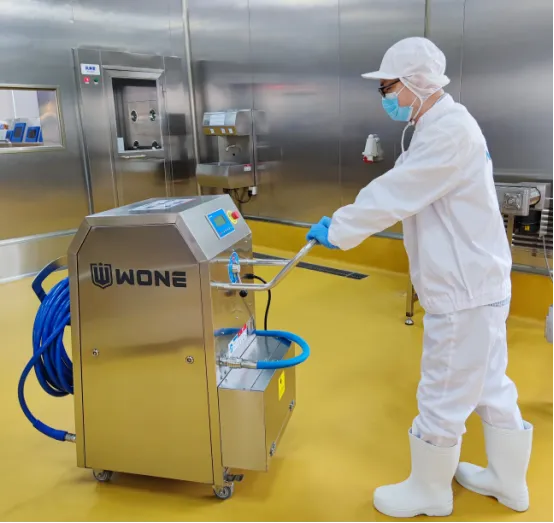
To address these challenges, mobile multifunctional foam cleaning machines are designed to provide a more flexible cleaning solution for small food factories.
They can integrate three essential functions:
High-pressure rinsing, foam cleaning, and disinfectant spraying.
A well-designed foam cleaning machine typically offers the following key advantages:
1. Integrated Valve Design for Simple Operation
A three-function integrated valve allows operators to quickly switch between foam cleaning, disinfection, and water rinsing.
With a simple valve adjustment, workers can switch between different cleaning functions without complicated valve operations, helping reduce operating errors.
2. Easy Mobility for Complete Workshop Coverage
With a push handle and durable wheels, the machine can easily move between different rooms, production areas, and corners.
Instead of being limited to one fixed cleaning point, operators can simply move the machine to wherever cleaning is required.
3. Color Coding for Easy and Error-Free Operation
The nozzles and integrated valve can use color-coded identification.
For example:
- Blue/green – water rinsing
- White – foam cleaning
- Yellow – disinfection
This allows operators to identify the correct function at a glance and helps prevent incorrect operation.
4. Accessory Holder for Better Organization and Hygiene
A dedicated spray gun and nozzle holder keeps accessories organized and easy to access.
This helps prevent nozzles from being placed randomly on the floor or other surfaces, reducing the risk of contamination, loss, and damage.
5. Better Chemical Control for Safer Cleaning
Locked chemical tank:
The chemical tank can be kept in a locked condition to prevent unauthorized access or accidental misuse of cleaning chemicals.
Accurate concentration control:
A chemical concentration adjustment valve helps maintain a stable chemical concentration, supporting consistent cleaning performance.
6. Smart System for Data Traceability
The machine can be equipped with an i-clean controller to monitor the consumption of water and cleaning/disinfection chemicals.
With remote data transmission, relevant consumption information can also be sent to managers’ mobile devices, supporting more digital and traceable hygiene management.
3. Practical Selection Guide: How to Choose the Right Machine for Your Workshop
With different models and configurations available, how should you choose the right one?
Here are the key factors to consider.
Step 1: Understand Your Cleaning Environment
Is your workshop centralized or divided into multiple areas?
For a distributed layout with multiple small rooms:
A mobile foam cleaning machine is usually the better choice. With a 220V power supply, it is flexible and can be easily moved between different production areas.
For a centralized, open workshop:
A smart foam cleaning machine can be considered. With higher power, cleaning pressure of up to 20 bar, and a 25-meter automatic hose reel, it provides a larger working radius and higher cleaning efficiency.
What are your cleaning requirements?
If you only need foam cleaning:
If your main goal is to remove grease and dirt, a water hose and a mobile foam trolley may meet basic cleaning needs. However, its functions are relatively limited and may not provide high-pressure rinsing or disinfection.
If you need complete cleaning and disinfection:
A mobile foam cleaning machine or smart foam cleaning machine is a better choice. One machine can handle multiple cleaning functions, improving efficiency and reducing the need for multiple pieces of equipment.
Step 2: Compare Key Parameters and Choose the Right Configuration
| Comparison Item | Mobile Foam Cleaning Machine | Smart Foam Cleaning Machine |
|---|---|---|
| Suitable Applications | Small workshops, multiple rooms, flexible operation | Medium-sized workshops, open areas, fixed cleaning points |
| Power Supply | 220V, standard power outlet | 380V, industrial power supply |
| Cleaning Pressure | >16 bar | 18–25 bar |
| Hose Length | 15 m standard, extendable | 25 m automatic hose reel |
| Main Advantage | Flexible mobility without requiring 380V power | Higher power, greater automation, and larger working radius |
Selection Recommendations
- For newly established small factories or workshops with limited power supply: Choose a mobile foam cleaning machine. It offers excellent flexibility and relatively low investment. With three functions—high-pressure rinsing, foam cleaning, and disinfection—it only requires a 220V power supply and water connection. It is particularly suitable for workshops that are not large but still have high hygiene requirements.
- For larger facilities focused on cleaning efficiency: Choose a smart foam cleaning machine. It is better suited to fixed cleaning points and larger working areas. Higher cleaning pressure and an automatic hose reel can significantly improve end-of-shift cleaning efficiency while supporting smarter hygiene management.
4. Comparing Different Solutions and Making the Right Decision
In addition to standalone machines, suppliers can also provide centralized solutions such as centralized chemical concentrate systems and centralized chemical concentrate/high-pressure water systems.
For small factories, a standalone machine is generally more cost-effective and flexible because it does not require complicated pipeline installation.
| Solution | Smart Foam Cleaning Machine (Standalone) | Centralized Chemical Concentrate System |
|---|---|---|
| Initial Investment | Lower; one machine with simple connections | Higher; requires a central station and piping |
| Expansion | Flexible; additional machines can be added as needed | More complex; system layout needs to be planned in advance |
| Chemical Management | Chemicals need to be managed at the cleaning site | Chemicals can be centrally managed outside the workshop, reducing risks |
| Flexibility | Different types of chemicals can be used as required | Changing chemical types can be less flexible |
Conclusion: For workshops covering a few hundred square meters, a standalone solution—either a mobile or smart foam cleaning machine—is generally the most practical and cost-effective choice.
5. Conclusion: How to Start Building Your Cleaning Solution
For small food factories with workshops covering a few hundred square meters, the key to an effective cleaning solution is:
Flexibility, efficiency, and safety.
1. Recommended Solution
Depending on the workshop layout and available power supply, choose either a mobile foam cleaning machine or a smart foam cleaning machine.
It can provide an integrated solution for basic cleaning and disinfection needs without requiring a complicated cleaning system.
2. Supporting Tools
Consider using an extension lance to reach higher or more distant surfaces and equipment, making the cleaning process even more flexible.
3. Standardize the Cleaning Process
Remember the four key factors of effective foam cleaning:
Mechanical action + Temperature + Chemicals + Time
After foam application, a contact time of approximately 10–15 minutes is recommended, allowing the foam and cleaning chemicals enough time to work effectively.
Don’t let complicated cleaning procedures slow down your production. With the right cleaning equipment, even a few-hundred-square-meter workshop can be cleaned efficiently and effectively—helping you maintain better hygiene and stronger food safety.