A central kitchen is usually divided into several independent production areas. Meat preparation, seafood processing, vegetable washing, cooking and packaging may all take place in separate rooms within the same facility.
Although these rooms belong to one central kitchen, their cleaning requirements can be quite different. Some areas deal with grease and protein residues, while others need to remove soil, food particles or other organic matter.
For kitchen managers and sanitation teams, the challenge is not simply how to clean each room. It is how to arrange cleaning equipment so that daily cleaning is practical, consistent and suitable for different production areas.
Choosing a foam cleaning machine for a central kitchen therefore requires more than checking the machine’s power or pressure. The layout of the facility, the number of cleaning points, hygiene zoning and cleaning frequency should all be considered.
1. Why Is Cleaning Equipment Planning Important in a Central Kitchen?
Unlike a single-room commercial kitchen, a central kitchen often has several production rooms with different functions.
A typical layout may include:
- Raw meat and poultry preparation rooms
- Seafood processing rooms
- Vegetable washing and preparation areas
- Cooking and food processing rooms
- Cooling and intermediate handling areas
- Packaging and finished product rooms
- Equipment and utensil washing areas
Each area may have different equipment, working surfaces and types of food residues.
For example, meat preparation rooms may have fat, blood and protein residues on tables and equipment. Seafood rooms may have fish residues and organic matter. Cooking areas often need to deal with grease deposits, while vegetable preparation rooms may have soil and plant residues.
These differences affect detergent selection, cleaning methods and the frequency of cleaning.
A cleaning setup that works well in one room may not be suitable for another. This is why central kitchens should plan cleaning equipment according to actual production activities rather than simply buying the same equipment for every room.
2. Three Common Cleaning Challenges in Multi-Room Central Kitchens
Different Rooms Have Different Cleaning Requirements
Food residues vary depending on the ingredients and processing activities.
Grease, protein, starch, soil and other organic residues may require different detergents and cleaning procedures. The chemical concentration and contact time should follow the detergent manufacturer’s instructions.
Using the same cleaning method everywhere may not deliver the expected result.
A better approach is to identify the main contamination in each room and establish a suitable cleaning procedure for that area.
Cleaning Points Are Spread Across the Facility
In some central kitchens, cleaning points are concentrated in one production area. In others, several independent rooms are distributed across a large facility.
If a cleaning machine is installed in only one location, workers may need to move equipment or hoses over long distances. This can make daily cleaning less convenient.
Installing a separate machine in every room is another option, but it may increase equipment investment and maintenance requirements.
The practical solution depends on how many cleaning points need to be served and how frequently each area is cleaned.
Preventing Cross-Contamination Between Production Areas
Equipment movement is also a hygiene consideration.
For example, a machine used in a raw meat preparation area should not be moved directly into a cooked food or ready-to-eat packaging area without appropriate cleaning and disinfection controls.
Central kitchens should consider hygiene zoning, equipment storage, cleaning schedules and movement routes before deciding whether one machine can serve multiple rooms.
The key point is that equipment sharing must follow the facility’s hygiene procedures. Convenience should never come at the expense of cross-contamination control.
3. How to Choose the Right Cleaning Method for Different Rooms
A foam cleaning machine is useful for applying detergent to suitable washable surfaces. However, not every room in a central kitchen should use exactly the same cleaning method.
| Production area | Common residues | Cleaning considerations |
|---|---|---|
| Meat and poultry | Fat, blood, protein | Suitable detergent, pre-rinsing and thorough rinsing |
| Seafood | Organic residues, fish residues | Regular cleaning and suitable drainage |
| Vegetable preparation | Soil, plant residues | Remove visible debris before washing |
| Cooking area | Grease and food deposits | Detergent suitable for grease removal |
| Packaging area | Dust and food particles | Moisture control and hygiene zoning |
Meat and Poultry Preparation
Meat preparation areas often require regular cleaning of stainless steel worktables, equipment exteriors and surrounding floors.
A suitable wet-cleaning process may include removing visible food residues, pre-rinsing, applying detergent foam, allowing the recommended contact time and rinsing thoroughly.
Manual cleaning may still be needed around joints, corners and difficult-to-reach parts.
Seafood Processing
Seafood processing areas may involve frequent contact with water and organic residues.
Cleaning procedures should consider the type of seafood being handled, the equipment materials and the drainage arrangement.
Foam cleaning equipment can help apply detergent to suitable open surfaces, but it does not replace manual cleaning where residues accumulate in gaps or equipment components.
Vegetable Preparation
Vegetable preparation rooms may contain soil, leaves and other plant residues.
Removing visible debris before applying detergent can make subsequent cleaning more effective.
Drainage and the direction of water flow should also be considered to prevent residues from spreading to other areas.
Cooking and Food Processing
Cooking areas may accumulate grease around cooking equipment, worktables and nearby surfaces.
The detergent should be suitable for the type of grease and the material being cleaned. Electrical components and sensitive equipment must be protected during wet cleaning.
Packaging and Finished Product Areas
Packaging areas may have stricter hygiene and moisture-control requirements.
Wet foam cleaning should only be used when it is suitable for the room, equipment and production process. In low-moisture areas, dry cleaning or controlled cleaning methods may be more appropriate.
This is why a central kitchen needs a cleaning plan based on the function of each room, rather than one universal cleaning method.
4. Why Consider a Mobile Foam Cleaning Machine?
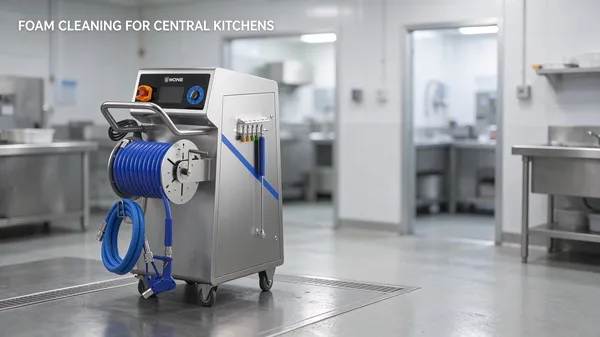
For central kitchens with several independent preparation rooms, a mobile foam cleaning machine can be a practical option.
Unlike a fixed system, a mobile machine can be moved between suitable cleaning points. This may be useful when cleaning tasks are distributed across different rooms and do not all need to take place at the same time.
The main advantages include:
Flexible movement
Workers can move the machine to different suitable cleaning areas according to the cleaning schedule.
Multiple cleaning points
One machine may serve several areas when its capacity, hose arrangement and cleaning schedule allow.
Less fixed installation
A mobile setup may reduce the need to install a separate fixed cleaning machine in every room.
Convenient daily operation
Operators can carry out rinsing and foam application using the machine’s available operating modes.
However, a mobile machine is not automatically the best choice for every central kitchen.
The distance between rooms, floor layout, door access, water supply and hygiene zoning all need to be considered. If two areas have strict separation requirements, dedicated cleaning equipment may be more appropriate.
5. Mobile vs. Fixed Foam Cleaning Systems: Which Should You Choose?
Both mobile and fixed foam cleaning machines can be used in suitable food processing environments. The difference is mainly in how cleaning equipment is arranged and operated.
When Is a Mobile System More Suitable?
A mobile foam cleaning machine may be a better option when:
- Several separate rooms require routine cleaning.
- Cleaning points are spread across the facility.
- Workers need to move equipment between different areas.
- The cleaning schedule allows one machine to serve multiple locations.
- Flexible equipment use is more important than permanent installation.
When Is a Fixed System More Suitable?
A fixed foam cleaning machine may be more practical when:
- Cleaning activities are concentrated in one area.
- The machine has a permanent operating position.
- The facility has suitable water and electrical connections.
- Cleaning operations are frequent and follow a stable routine.
- Equipment movement between rooms is unnecessary or restricted.
Comparing WONE Clean EFC-325W and EFC-325H
WONE Clean offers mobile and fixed foam cleaning equipment for different industrial cleaning arrangements.
| Specification | EFC-325W | EFC-325H |
|---|---|---|
| Equipment type | Mobile | Fixed |
| Power supply | 220V | 380V |
| Power | 3000W | 4000W |
| Water flow | Confirm configuration | More than 3 m³/h |
| Working pressure | Confirm configuration | 20 bar |
| Hose length | Confirm configuration | 25 m |
| Main advantage | Flexible movement | Fixed cleaning arrangement |
The final selection should be based on the available electrical supply, water conditions, cleaning requirements and workshop layout.
A machine with higher power is not necessarily the better choice. What matters is whether the equipment matches the actual cleaning tasks.
6. How to Plan the Number and Location of Cleaning Machines
One question often asked by central kitchen managers is whether every preparation room needs its own foam cleaning machine.
The answer is not always yes.
The number of machines should be determined by the number and distribution of cleaning points, cleaning frequency and hygiene zoning.
For example, consider a central kitchen with four rooms:
- Room A: Meat preparation
- Room B: Vegetable preparation
- Room C: Cooking
- Room D: Packaging
If the first three rooms have compatible wet-cleaning requirements and the cleaning schedule allows equipment movement, a mobile machine may be considered for those areas.
However, the packaging room may have different moisture-control requirements and may need a separate cleaning method.
This is an illustrative planning example, not a universal equipment configuration. The actual arrangement must be checked against the facility’s food safety procedures.
Before deciding how many machines to purchase, ask:
- How many rooms need wet cleaning?
- How far apart are the cleaning points?
- How often does each room need cleaning?
- Can cleaning equipment be shared safely between these areas?
- Are there rooms that require dedicated equipment?
In a multi-room central kitchen, the number and distribution of cleaning points can be more important than the total floor area when planning cleaning equipment.
7. A Practical Foam Cleaning Process for Central Kitchens
For suitable wet-cleaning areas, a typical cleaning process may include the following steps:
- Remove food residues: Clear visible food particles and waste from working surfaces and equipment.
- Pre-rinse: Use water to remove loose dirt where wet cleaning is appropriate.
- Apply detergent foam: Apply a suitable detergent to the required surfaces.
- Allow contact time: Follow the chemical manufacturer’s recommended contact time.
- Rinse thoroughly: Remove loosened residues and detergent.
- Disinfect when required: Apply an approved disinfectant according to the required concentration and contact time.
- Verify cleaning: Use visual inspection, cleaning records or appropriate testing methods.
It is important to distinguish cleaning from disinfection. Cleaning removes dirt and food residues, while disinfection is a separate operation intended to control microorganisms.
Foam application alone does not prove that a surface is clean or disinfected. The complete procedure, including chemical selection, contact time and verification, must be followed.
8. What Should You Check Before Buying a Foam Cleaning Machine?
Before purchasing a foam cleaning machine for a central kitchen, consider these five factors.
1. Workshop layout
Understand the number of rooms, their locations and the distance between cleaning points.
2. Hygiene zoning
Check whether equipment can be shared between different production areas without creating cross-contamination risks.
3. Power supply
Confirm voltage, frequency, phase and power requirements. For example, EFC-325W uses 220V, while EFC-325H uses 380V.
4. Water supply
Check water pressure, flow rate, inlet connections and drainage conditions.
5. Hose length and equipment movement
Consider the distance to the furthest cleaning point, access between rooms and where the machine will be stored when not in use.
These details help avoid choosing equipment that looks suitable on paper but is inconvenient in daily operation.
9. Frequently Asked Questions
Does every room in a central kitchen need a separate foam cleaning machine?
No. Some rooms may share a mobile machine if their cleaning requirements, schedules and hygiene controls allow. Other areas may need dedicated equipment.
Is a mobile foam cleaning machine suitable for a large central kitchen?
It can be suitable when cleaning points are spread across several areas. However, the facility should check the machine’s capacity, hose coverage, movement routes and cleaning schedule.
Can a foam cleaning machine clean all food processing equipment?
No. Foam cleaning is suitable for compatible washable surfaces and equipment exteriors. Some equipment requires disassembly, manual cleaning or special cleaning procedures.
Can the same cleaning machine be used in raw and cooked food areas?
Only when the facility’s approved hygiene procedures allow it and appropriate cleaning and disinfection controls are in place. Dedicated equipment may be necessary in some facilities.
How do I choose between EFC-325W and EFC-325H?
Consider the cleaning layout first. EFC-325W is a mobile model for flexible movement, while EFC-325H is designed for fixed cleaning arrangements. Electrical supply, water conditions and cleaning requirements should also be checked.
10. Looking for a Cleaning Solution for Your Central Kitchen?
Every central kitchen has a different room layout, production process and cleaning schedule.
WONE Clean manufactures industrial foam cleaning equipment for food processing and food production facilities.
Whether you need a mobile foam cleaning machine for several preparation rooms or a fixed system for a dedicated cleaning area, our team can help review your requirements and recommend a suitable equipment configuration.
Share your workshop layout, number of rooms, main food processing activities and available power supply with us.
Contact WONE Clean to discuss your central kitchen cleaning requirements.
References
- Codex Alimentarius, General Principles of Food Hygiene (CXC 1-1969), revised 2022.
- U.S. FDA, 21 CFR 117.35 – Sanitary Operations.
- European Commission Joint Research Centre, Best Available Techniques Reference Document for the Food, Drink and Milk Industries, 2019.