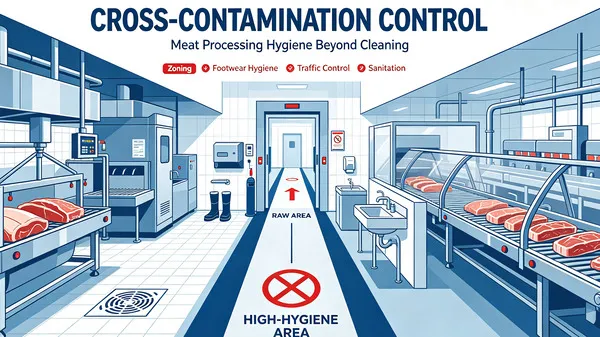
Meat processing hygiene is not only about keeping equipment and food-contact surfaces clean. In a busy meat processing facility, workers, footwear, tools, equipment, and materials can all carry contaminants from one area to another. Effective hygiene therefore requires controlling how contamination moves through the facility—not simply cleaning it after it happens.
According to the U.S. Department of Agriculture (USDA) Food Safety and Inspection Service (FSIS), meat and poultry establishments must maintain sanitary conditions and clean and sanitize food-contact and non-food-contact surfaces as frequently as necessary to prevent contamination.
For many plants, the question is not simply “Are we cleaning enough?”
It is:
“Can contamination move from a dirty area into a clean area after we have cleaned it?”
Where Does Cross-Contamination Start?
In a meat processing facility, contamination can move through several routes:
- Employee footwear
- Hands and gloves
- Protective clothing
- Knives and small tools
- Processing equipment
- Floors and drains
- Cleaning equipment and water
- Movement between raw and higher-hygiene areas
Personnel movement is particularly easy to overlook.
For example, a worker may leave a raw meat area, walk through a corridor, and enter another production zone without realizing that contamination has been carried on the soles of their boots.
FSIS guidance specifically identifies practices such as boot washing or changing to designated footwear, changing outer clothing, and handwashing when moving between certain production areas as measures that can help prevent cross-contamination.
This leads to an important principle:
You cannot control cross-contamination effectively if you only control the product. You also need to control the route.
1. Separate Raw and High-Hygiene Areas
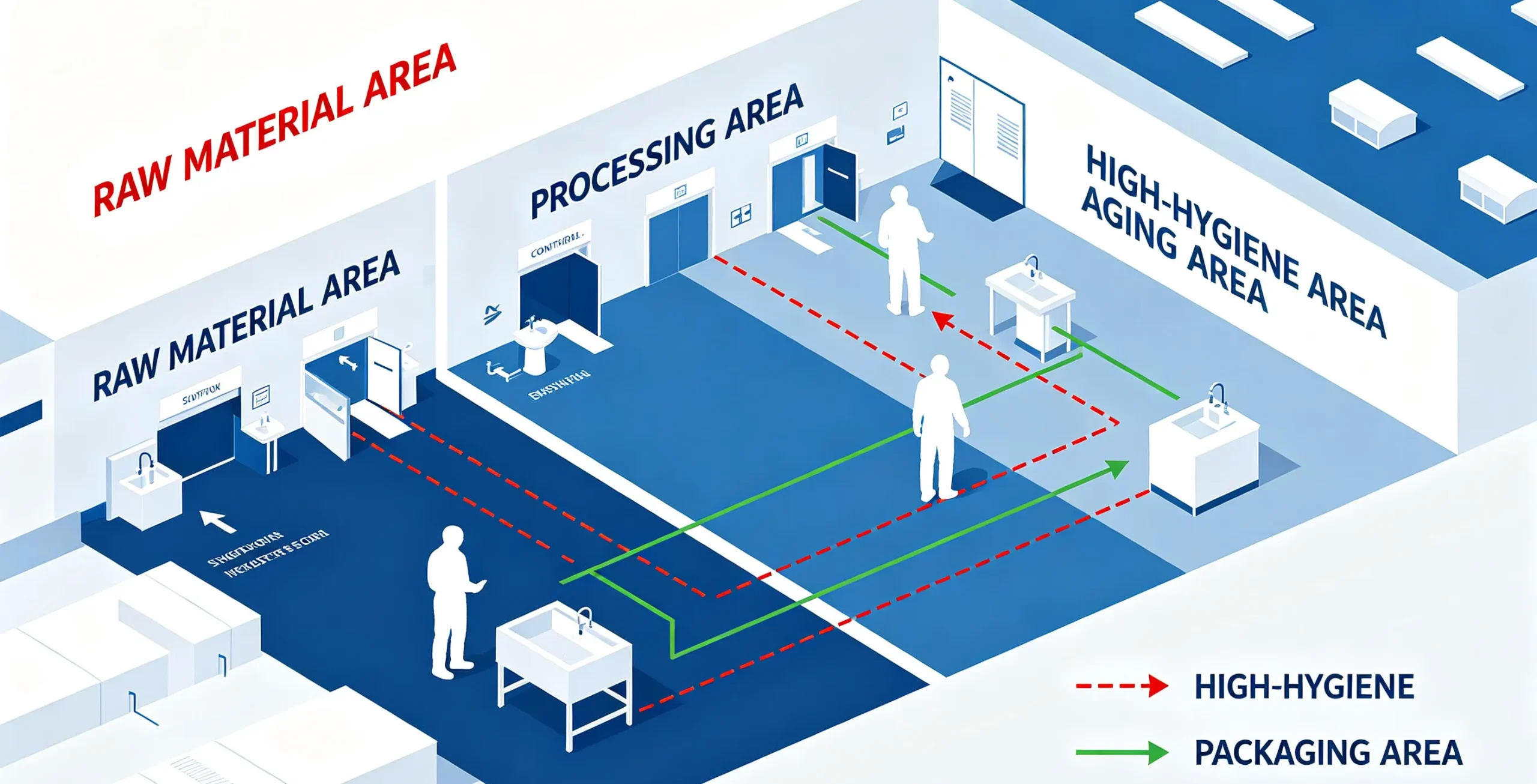
The first step is to establish clear hygiene zones.
A typical meat processing plant may have:
Raw Material Area → Processing Area → High-Hygiene / Packaging Area
The exact zoning depends on the product and process, but the principle remains the same: prevent uncontrolled movement from lower-hygiene areas into higher-hygiene areas.
Physical separation is helpful, but it is not enough.
Factories also need to consider:
- Where employees change footwear
- Where workers wash their hands
- Where boots are cleaned
- Which doors employees use
- How cleaning staff move through the plant
- How equipment and materials are transferred
A good hygiene layout makes the correct behavior easier to follow.
2. Control Footwear at Hygiene Entry Points
Boots are often treated as a simple cleaning issue.
In reality, they are a traffic-control issue.
A boot can contact floors, drains, meat residues, grease, water and other contaminants throughout the production day. If the same footwear then enters a cleaner area, contamination can travel with it.
This is why footwear hygiene should be located at the transition point between hygiene zones, rather than somewhere employees have to make a separate trip to use.
A practical flow could look like:
Changing Room → Footwear Cleaning → Hand Hygiene → Controlled Entry → Production Area
The objective is not to make boots look clean.
The objective is to reduce the chance that contaminants are transferred from one zone to another.
3. Use Mechanical Cleaning Instead of Relying Only on Manual Cleaning
Manual boot cleaning can work in small facilities, but it becomes harder to control as the workforce grows.
Workers may clean for different lengths of time. Some may clean only the visible parts of the sole. Others may rush when a shift is starting.
This creates a consistency problem.
A mechanical shoe sole cleaning machine can standardize the cleaning step by using rotating brushes and controlled water or detergent application.
For meat processing plants, this can be particularly useful where many employees pass through the same hygiene entrance during a short period.
The key question when choosing equipment should therefore not be:
“Can it clean a boot?”
It should be:
“Can it provide a repeatable cleaning process for hundreds of workers every day?”
4. Do Not Confuse Cleaning With Disinfection
Another common mistake is treating cleaning and disinfection as the same operation.
They are not.
Cleaning removes dirt, organic material and residues. Disinfection or sanitization is a separate step intended to reduce microorganisms under defined conditions.
This distinction matters in meat processing because organic material such as fat and protein can interfere with sanitation processes.
A practical footwear hygiene process may therefore include:
Mechanical brushing → Water/detergent cleaning → Rinsing → Disinfection when required → Controlled entry
The exact chemicals, concentration, contact time and frequency should always follow the plant’s sanitation program and chemical supplier instructions.
5. Design Hygiene Around Real Worker Traffic
One of the biggest differences between a good hygiene system and a good-looking hygiene system is worker behavior.
If 150 workers need to enter production at the same time, a slow or inconvenient hygiene procedure creates queues.
And when workers are under time pressure, procedures are more likely to be rushed or bypassed.
This is why meat processing hygiene equipment should be evaluated based on:
- Worker throughput
- Cleaning consistency
- Ease of use
- Maintenance
- Drainage
- Space requirements
- Integration with the existing hygiene flow
The best hygiene system is the one workers can actually use correctly during a busy production shift.
6. Keep the Hygiene Equipment Clean
There is another issue that is sometimes missed:
A hygiene machine also needs its own sanitation program.
Brushes, spray nozzles, drainage areas and surrounding floors can accumulate organic residues if they are not maintained properly.
Routine checks should include:
- Brush condition
- Water supply
- Detergent supply
- Drainage
- Residue accumulation
- General equipment cleanliness
FSIS requires sanitation procedures to be effective in preventing direct contamination and maintaining sanitary conditions.
So installing equipment is only part of the solution. The equipment itself must remain part of the hygiene system.
7. Make Footwear Hygiene Automatic Where Practical
For plants with high employee traffic, automation can make hygiene procedures more consistent.
The Automatic Shoe Sole Cleaning Machine PBW-11W is designed for this type of application. It uses a sensor to detect footwear and automatically starts the cleaning process, while rotating brushes clean the shoe or boot soles.
Automatic Shoe Sole Cleaning Machine PBW-11W
The value of this type of equipment is not simply that it cleans shoes.
It creates a defined hygiene control point.
Instead of asking every worker to decide how and when to clean their footwear, the plant can place the cleaning process directly into the employee flow before entering a controlled production area.
For meat processors looking to improve personnel hygiene, footwear hygiene and cross-contamination prevention, this can be a relatively simple improvement without redesigning the entire production line.
A Practical Cross-Contamination Control Strategy
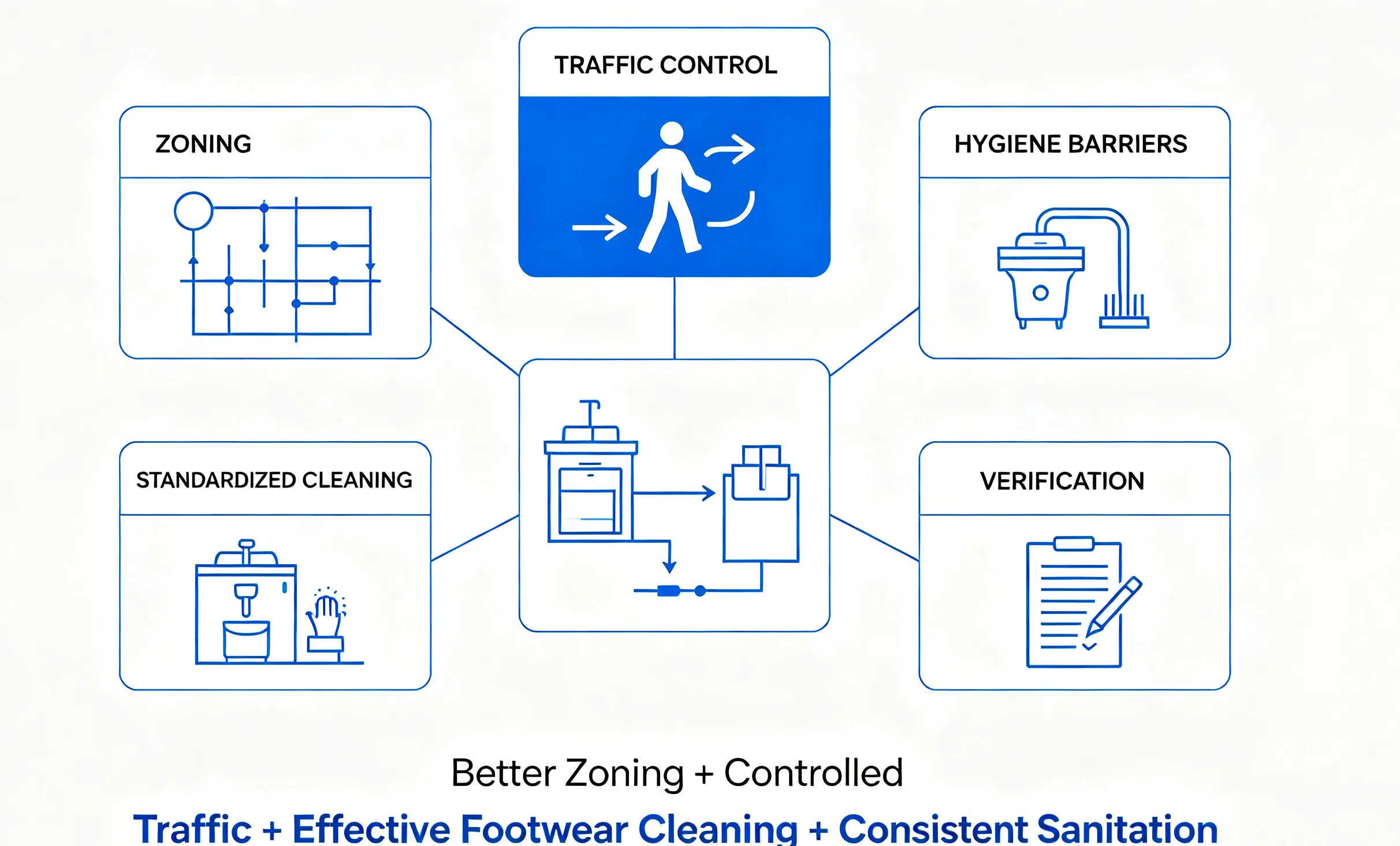
For most meat processing facilities, an effective approach can be built around five basic controls:
1. Zoning
Separate raw and higher-hygiene areas.
2. Traffic control
Define how people, footwear, tools and materials move between zones.
3. Hygiene barriers
Use handwashing, footwear cleaning and other controls at critical transition points.
4. Standardized cleaning
Reduce dependence on inconsistent manual cleaning where automation is practical.
5. Verification
Monitor sanitation procedures, equipment condition and employee compliance.
HACCP systems are built around identifying hazards and establishing controls for hazards reasonably likely to occur. Sanitation is one of the important supporting elements of that system.
Final Takeaway
Cross-contamination in a meat processing facility is not only a cleaning problem.
It is a movement problem.
Contaminants can move with workers, boots, tools, equipment, water and materials. Therefore, the most effective strategy is to control those movement routes before contamination reaches a higher-hygiene area.
For meat processors, improving meat processing hygiene is ultimately about making contamination control consistent throughout the entire production flow.
Better zoning + controlled traffic + effective footwear cleaning + consistent sanitation = stronger cross-contamination control.
The goal is not to add more procedures.
The goal is to make the correct hygiene behavior easy, repeatable and difficult to bypass.