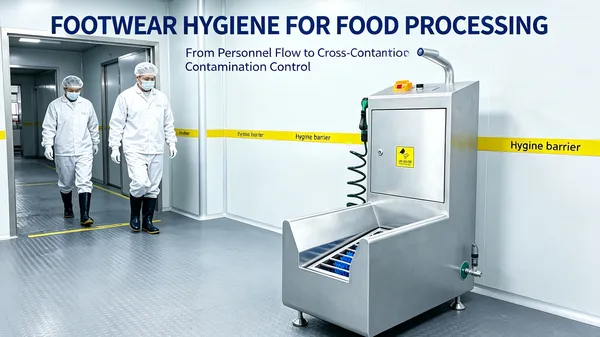
Footwear is often overlooked in food processing hygiene programs.
Employees wash their hands, equipment is sanitized, and floors are cleaned regularly. But work boots can still carry dirt, organic residues, grease, moisture, and microorganisms between different areas of a facility.
This becomes especially important when employees move between raw-material areas, production rooms, changing rooms, and higher-hygiene zones.
Footwear hygiene should therefore be treated as part of personnel hygiene and traffic control—not simply as a boot-cleaning task.
Why Footwear Hygiene Matters
Boot soles come into direct contact with floors, drains, standing water, food residues, and other materials throughout the working day.
If an employee moves from a lower-hygiene area into a higher-hygiene area without an appropriate footwear control step, contaminants can potentially be transferred between zones.
USDA FSIS guidance recognizes footwear as part of cross-contamination control and recommends measures such as boot washing or changing to designated footwear where appropriate.
The goal is not simply to make boots look clean. The goal is to control the movement of potential contaminants between hygiene zones.
1. Start With Personnel Flow
Before selecting footwear cleaning equipment, look at how employees actually move through the facility.
Identify:
- Where employees enter the plant
- Where footwear is changed
- Raw and high-hygiene areas
- Main transition points
- Areas where employees move between different zones
The best location for footwear hygiene is usually a transition point.
For example:
Changing Room → Footwear Cleaning → Hygiene Barrier → Production Area
When the cleaning point is directly on the employee route, hygiene becomes part of the normal workflow instead of an additional task.
2. Define Hygiene Zones
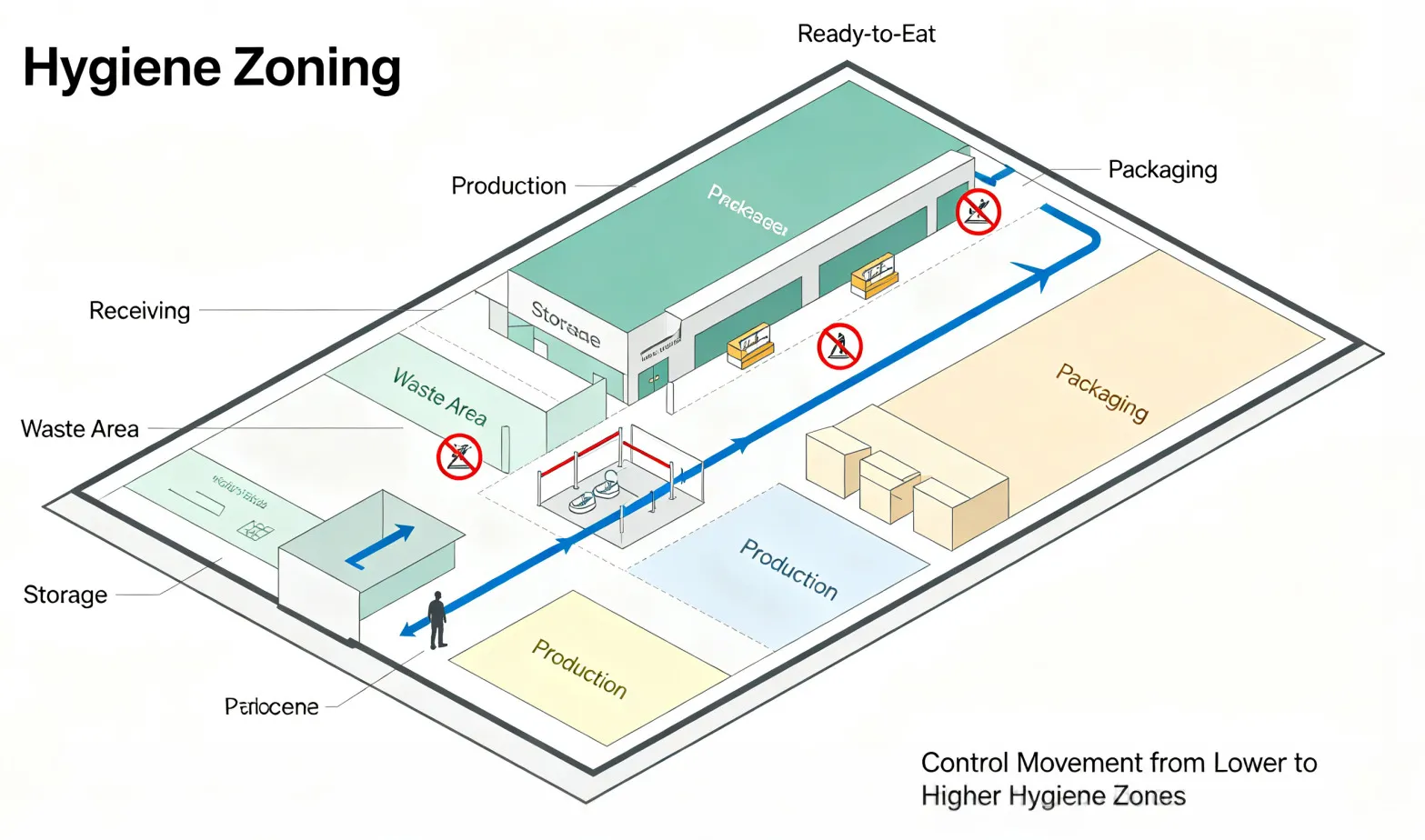
Different areas of a food processing plant may have different hygiene requirements.
Receiving areas, waste areas, storage rooms, production areas, and ready-to-eat or packaging areas may require different levels of footwear control.
The exact zoning system depends on the facility’s food safety plan, product, and production process.
The key principle is simple:
Prevent uncontrolled movement from lower-hygiene areas into higher-hygiene areas.
Footwear cleaning, dedicated footwear, and controlled personnel movement can work together to create a practical hygiene barrier.
3. Clean the Entire Sole
A boot may look clean while still retaining contamination inside its tread.
Boot soles can collect:
- Soil
- Food residues
- Grease
- Organic material
- Moisture
Simple rinsing may remove loose dirt, but mechanical cleaning can provide more consistent contact with the sole surface.
This is why rotating brushes can be useful for footwear cleaning in busy food processing environments.
The objective is to establish a repeatable cleaning process rather than relying entirely on how thoroughly each employee cleans their own boots.
4. Match Cleaning to the Contamination
Water and detergent do different jobs.
Water can help remove loose contamination, while detergent may be required when dealing with grease, fats, proteins, or other residues.
A practical process may include:
Mechanical brushing → Water → Detergent when required → Rinsing → Controlled entry
The specific chemical, concentration, and contact time should follow the facility’s sanitation program and chemical supplier instructions.
It is also important to distinguish between cleaning and disinfection.
Cleaning removes soil and organic material. Disinfection or sanitization is a separate control step and needs to be applied under suitable conditions.
5. Make Footwear Hygiene Fast
A good hygiene procedure must work during real production conditions.
If 100 employees arrive at a production area at the same time, a slow manual cleaning process can create queues and encourage workers to rush or bypass the procedure.
Therefore, footwear hygiene equipment should be evaluated for:
- Cleaning effectiveness
- Cleaning speed
- Employee throughput
- Ease of use
- Maintenance requirements
- Fit with the facility layout
The best hygiene barrier is not necessarily the most complicated one. It is the one employees can consistently use without disrupting production.
6. Maintain the Cleaning Equipment
A boot cleaning machine also needs to be included in the sanitation program.
Brushes, spray nozzles, water lines, drains, and surrounding surfaces can accumulate residues if they are not maintained properly.
Routine inspections should include:
- Brush condition
- Water and detergent supply
- Spray nozzles
- Drainage
- Residue accumulation
- General equipment cleanliness
A dirty boot washer can become another source of contamination, so equipment hygiene is just as important as footwear hygiene.
7. Train Employees
Employees should understand not only how to clean their footwear, but why the procedure matters.
A simple message can be effective:
Your footwear can move contamination from one hygiene zone to another. Cleaning your boots helps protect the next production area.
Training should explain when footwear cleaning is required, how to use the equipment, which footwear belongs to each zone, and what to do if the cleaning system is not working.
This helps turn footwear cleaning from a routine requirement into a meaningful part of the food safety system.
A Practical Footwear Hygiene Process
For many food processing plants, a simple system can follow these steps:
1. Define hygiene zones
Identify where footwear controls are required.
2. Control personnel flow
Determine how employees move between zones.
3. Install the hygiene point at the transition
Place footwear cleaning directly on the employee route.
4. Clean the footwear effectively
Use mechanical brushing with water or detergent as required.
5. Control entry
Combine footwear hygiene with other personnel hygiene measures when necessary.
6. Maintain and verify the system
Inspect equipment, drainage, cleaning performance, and employee compliance.
Automatic Footwear Cleaning for Food Processing Plants
For smaller facilities, manual boot cleaning may be sufficient. However, larger plants can benefit from a more standardized process.
An automatic shoe sole cleaning machine can reduce dependence on manual scrubbing and provide a consistent cleaning action at a controlled entry point.
The [Automatic Shoe Sole Cleaning Machine PBW-11W] is designed for cleaning shoe and boot soles before employees enter hygiene-controlled production areas. The sensor starts the cleaning process automatically, while rotating brushes remove dirt and residues from the footwear sole.
For facilities looking to improve footwear hygiene without adding unnecessary complexity, the PBW-11W can serve as a practical footwear cleaning point within the personnel hygiene flow.
Final Takeaway
Footwear hygiene is more than keeping boots clean.
It is about controlling how potential contaminants move through the facility.
A practical system combines:
Hygiene zoning + controlled personnel flow + effective footwear cleaning + employee training + equipment maintenance.
When footwear cleaning is positioned at the right transition point and designed around real employee movement, it becomes a practical food safety barrier rather than another procedure workers may forget.
The goal is simple: clean footwear, controlled movement, and a more consistent hygiene process.