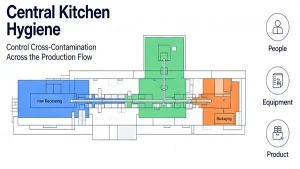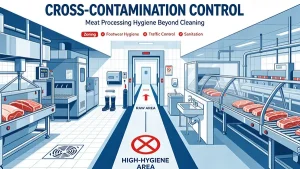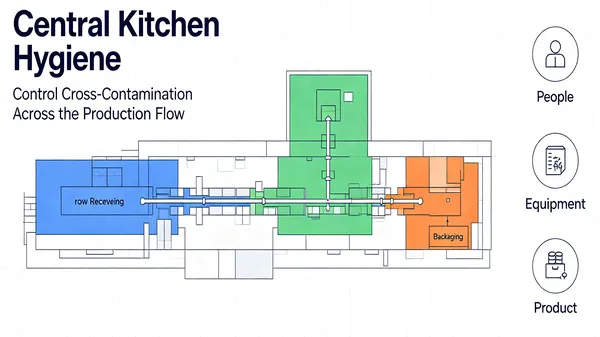
Central kitchen hygiene is essential for controlling cross-contamination in facilities where large volumes of ingredients, food products, people and equipment move through the same production environment. Effective hygiene management covers more than cleaning food-contact surfaces. It also includes equipment sanitation, floor and drain cleaning, personnel hygiene, footwear hygiene, chemical control and the separation of high- and low-risk production areas.
The U.S. CDC estimates that foodborne illnesses cause about 48 million illnesses, 128,000 hospitalizations and 3,000 deaths each year in the United States. For central kitchens, this highlights why cleaning and sanitation need to be integrated into daily production processes rather than treated as routine housekeeping.
1. Build Cleaning Around the Production Flow
A central kitchen should not treat every area in the same way.
Raw material receiving, raw meat and seafood preparation, cooking, cooling, ready-to-eat food preparation and packaging may have very different contamination risks. The physical layout and cleaning procedures should help prevent contaminants from moving from high-risk areas into low-risk or ready-to-eat areas.
USDA guidance identifies cross-contamination as the transfer of harmful microorganisms between foods, utensils, surfaces and people. Raw meat, poultry, seafood and eggs require particular attention because their juices can transfer pathogens to ready-to-eat foods and other surfaces.
A practical central-kitchen hygiene system should therefore define:
- High-risk and low-risk zones
- Personnel movement routes
- Raw-material and finished-product routes
- Dedicated cleaning tools for different areas
- Cleaning frequency for different equipment and surfaces
- Footwear and hand hygiene requirements at zone entrances
- Waste and wastewater routes
The objective is not simply to make surfaces look clean. It is to control the movement of contamination through the facility.
2. Clean First, Then Sanitize
One of the most important principles in food-industry sanitation is that cleaning and sanitizing are not the same operation.
Cleaning physically removes food residues, grease, dirt and other organic material. Sanitizing is the subsequent step intended to reduce microorganisms to an acceptable level.
USDA specifically recommends cleaning surfaces first and then sanitizing them, because sanitizers are more effective after food debris and other contaminants have been removed.
A typical cleaning sequence is:
Remove food residues → pre-rinse → apply detergent/foam → mechanical cleaning → rinse → sanitize → final inspection
The exact chemicals, concentration, temperature, contact time and method should follow the chemical manufacturer’s instructions and the site’s validated sanitation procedure.
This distinction is particularly important for central kitchens because grease, protein, starch and other food residues can accumulate quickly on processing equipment and floors. Applying disinfectant to a visibly dirty surface is not a substitute for proper cleaning.
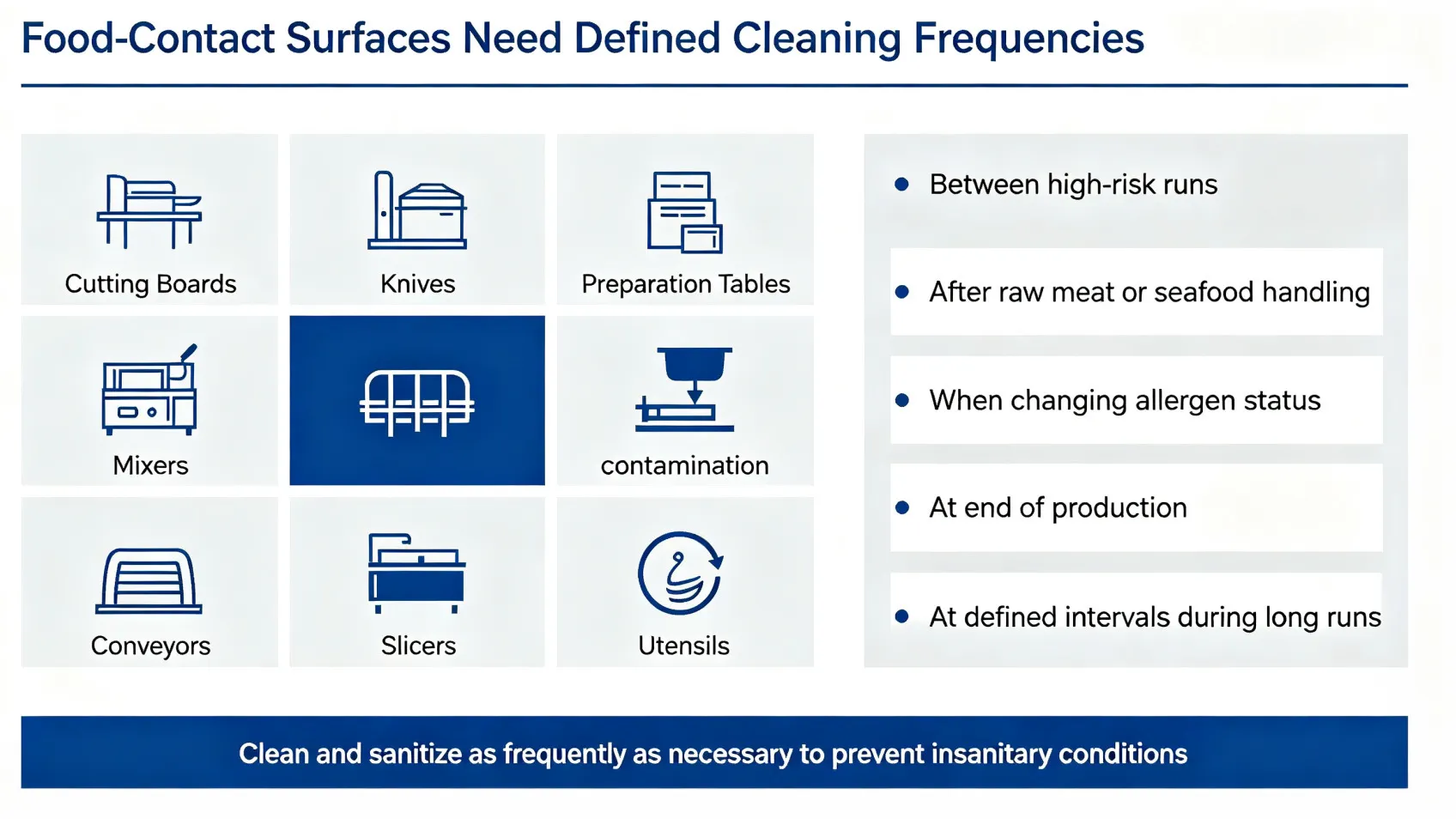
3. Food-Contact Surfaces Need Defined Cleaning Frequencies
Cutting boards, knives, preparation tables, mixers, conveyors, slicers, utensils and other food-contact equipment should be included in a documented sanitation schedule.
The FDA Food Code provides a science-based framework for food safety in foodservice and retail operations, and its provisions cover cleaning and sanitizing food-contact and non-food-contact surfaces.
For a central kitchen, cleaning frequency should be based on the actual production process rather than a generic “once per day” rule.
For example:
- Between different high-risk production runs
- After handling raw meat or seafood
- When changing from allergen-containing to non-allergen production
- After equipment becomes visibly contaminated
- At the end of production
- At defined intervals during long production runs
USDA’s sanitation requirements for inspected food establishments similarly state that food-contact surfaces must be cleaned and sanitized as frequently as necessary to prevent insanitary conditions or product adulteration.
This means the sanitation schedule should be connected to production risk and process changes, not simply the clock.
4. Floors and Drains Are Part of the Hygiene System
Floors are often treated as a cleaning issue rather than a food-safety issue. In a central kitchen, that distinction can be problematic.
Water, grease, food residues and organic material can accumulate around equipment, floor-wall junctions and drains. If these areas are poorly designed or poorly maintained, they can become difficult-to-clean reservoirs for contamination.
USDA guidance for food processors emphasizes clean floors, functional drainage, the removal of standing water and the maintenance of surfaces without cracks or crevices that can harbor food material. It also warns that inappropriate pressure washing can drive food residues into cracks and difficult-to-clean areas.
A practical floor-cleaning program should therefore address:
- Food residues
- Grease and oil
- Standing water
- Floor drains
- Drain covers
- Wall-floor junctions
- Areas underneath equipment
- Traffic routes between production zones
The goal is to remove contamination rather than simply redistribute it with water.
5. Footwear Can Become a Cross-Contamination Route
Employees may walk through raw-material areas, production rooms, washing areas, corridors and changing rooms during a single shift. Their footwear can therefore become a physical carrier of contamination between zones.
This is particularly relevant in central kitchens with wet processing areas, meat or seafood preparation, slaughter-related supply chains, or other operations where organic residues can reach the floor.
Footwear hygiene should be considered together with:
- Personnel hygiene
- Zone separation
- Floor sanitation
- Entrance control
- Dedicated footwear
- Boot or shoe cleaning
- Disinfection where required by the site’s risk assessment
For facilities using low shoes or work shoes rather than tall food-processing boots, an automatic shoe sole cleaning machine can be used at appropriate transition points to remove contamination from the sole before personnel move into another hygiene-controlled area.
For example, WONE’s PBW-11W Automatic Shoe Sole Cleaning Machine is designed for personal shoe sole hygiene and can be positioned at personnel entrances or hygiene transition points. Its automatic sensor activation and cleaning modes allow it to be integrated into routine personnel movement rather than relying entirely on manual shoe cleaning.
The important principle is the location: footwear cleaning is most useful when it is placed at the point where personnel move between hygiene zones, rather than somewhere unrelated to the traffic flow.
6. Cleaning Chemicals Need Process Control
Using a stronger chemical does not automatically mean better sanitation.
A sanitation program needs to control:
- Correct chemical
- Correct concentration
- Correct application method
- Required contact time
- Water temperature where applicable
- Rinsing requirements
- Compatibility with the equipment and surface
- Chemical storage and labeling
The FDA Food Code requires sanitizer concentration to be accurately determined using an appropriate test kit or other device.
For central kitchens, chemical management should therefore be incorporated into the sanitation SOP rather than left to individual operators.
This also makes sanitation easier to audit because the facility can document what was used, where it was used, at what concentration and according to which procedure.
7. High-Pressure Cleaning Requires the Right Application
High-pressure water is useful for removing residues from many industrial surfaces, but pressure alone is not a sanitation program.
Poorly controlled pressure washing can spread contaminated water, aerosols and food residues into adjacent areas. USDA guidance specifically notes that pressure washing can drive food material into cracks and crevices where it may harbor pathogens.
For this reason, central kitchens should consider:
Where to clean → What to remove → Which detergent to use → How much mechanical action is required → Where wastewater will go → Which areas must be protected from splash or aerosol
Equipment selection should follow the cleaning task rather than simply choosing the highest available pressure.
8. Cleaning Records Should Reflect the Real Process
A sanitation checklist should do more than record a signature.
A useful cleaning record can identify:
| Item | Information to record |
|---|---|
| Area/equipment | What was cleaned |
| Cleaning method | Foam, manual cleaning, machine cleaning, etc. |
| Chemical | Product used |
| Concentration | Target concentration / verification |
| Frequency | When cleaning is required |
| Responsible person | Who completed the task |
| Verification | Visual or other defined inspection |
| Corrective action | What happened if the standard was not met |
For larger central kitchens, sanitation verification can also be supported by ATP testing, microbiological testing or other validated methods where appropriate.
The purpose of records is not paperwork for its own sake. They create evidence that the sanitation process is defined, repeatable and verifiable.
9. Hygiene Starts Before the Food Enters the Production Line
A central kitchen’s hygiene system does not begin at the preparation table.
It starts with the movement of people, raw materials, equipment and waste through the facility.
A strong hygiene layout typically combines:
Personnel hygiene + hand hygiene + footwear hygiene + equipment cleaning + food-contact sanitation + floor and drain management + zone separation + chemical control + sanitation verification
Each control addresses a different contamination route.
The FDA Food Code and USDA sanitation guidance both emphasize the need to control contamination through appropriate cleaning and sanitizing practices rather than relying on appearance alone.
For central kitchens, the practical question is therefore not simply:
“Is the kitchen clean?”
It is:
“Where can contamination enter, where can it accumulate, and how can the cleaning and sanitation process stop it from moving to the next production zone?”
That is the foundation of an effective central kitchen hygiene program.