Why Hygiene Stations Are Essential for Preventing Cross-Contamination in Food Factories
Cross-contamination in food factories does not always start with the product.
It can start with a pair of boots, a pair of hands, a door handle, a trolley, or an employee moving from one production area to another.
This is especially important in factories where raw materials and finished products are handled in different areas. If personnel move between these zones without proper hygiene controls, microorganisms, allergens, dirt, or organic residues can be carried into a cleaner production environment.
That is why personnel hygiene should be considered part of the factory’s process design, not just an employee training issue.
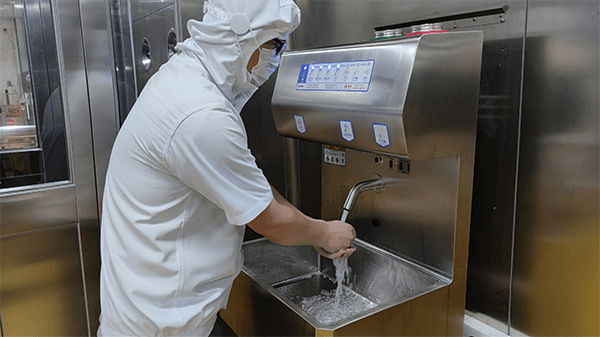
A well-designed hygiene station can create a controlled point between different hygiene zones, helping employees clean their hands, footwear, or other exposed areas before entering the next production area.
What Is Cross-Contamination in a Food Factory?
Cross-contamination occurs when a hazard is transferred from one person, surface, material, piece of equipment, or area to another.
In food processing, the transfer can happen in several ways:
- An employee moves from a raw material area to a finished-product area.
- Contaminated footwear carries residues across production zones.
- Hands touch raw materials and then food-contact surfaces.
- Gloves are used without proper hand cleaning.
- Employees touch doors, handles, tools, or equipment and then return to production.
- Cleaning equipment is moved between different hygiene zones.
- People cross between wet and dry areas without following the site’s hygiene procedures.
The Codex General Principles of Food Hygiene specifically identifies food handlers, contact surfaces, and air as possible routes for microbiological cross-contamination. It also recommends controlling access to higher-risk areas and, where appropriate, requiring personnel to change into clean protective clothing and footwear and wash their hands before entering.
So the question for a food factory is not simply:
“Are our employees washing their hands?”
A better question is:
“What can an employee carry from one zone to another, and where do we stop it?”
Why Personnel Can Become a Cross-Contamination Route
People move constantly around a food factory.
An employee may start the shift in a changing room, walk through a corridor, enter a raw material area, visit a warehouse, return to production, and later work near exposed food.
Every movement creates another opportunity for contamination to move with them.
Hands are an obvious route, but they are not the only one.
Hands
Hands can contact raw ingredients, waste containers, equipment, floors, doors, phones, tools, and other surfaces.
The risk increases when employees move between different tasks without washing their hands at the appropriate time.
Footwear
Footwear is often overlooked.
A worker may walk through an outdoor area or a raw processing zone and then enter a cleaner production area using the same footwear.
The boots may look clean but still carry residues or microorganisms.
For factories handling meat, poultry, seafood, or other wet raw materials, footwear hygiene can therefore be an important part of the overall hygiene barrier.
Protective Clothing
Aprons, coats, gloves, and other protective clothing can also transfer contamination when they are used across different hygiene zones.
This is why high-risk areas often require dedicated protective clothing and footwear rather than allowing the same items to move freely around the plant.
The Problem Is Not Always a Lack of Hygiene Equipment
Food factories often have handwashing facilities.
The bigger problem can be when and how employees use them.
A 2024 study observing food handlers in a sandwich manufacturing facility recorded 588 occasions when hand hygiene was required. Employees failed to wash their hands on 32% of those occasions. Among the 401 occasions when employees attempted hand hygiene, only 1% of the behaviors followed the company’s complete hand hygiene protocol. The study also found that 95% of attempts were shorter than the recommended 20-second washing duration.
This is an important distinction.
A factory can have a written hygiene procedure.
It can have posters on the wall.
It can have soap and sanitizer.
But if the process is inconvenient, easy to bypass, or disconnected from personnel movement, actual compliance may still be poor.
This is where the design of the hygiene entrance matters.
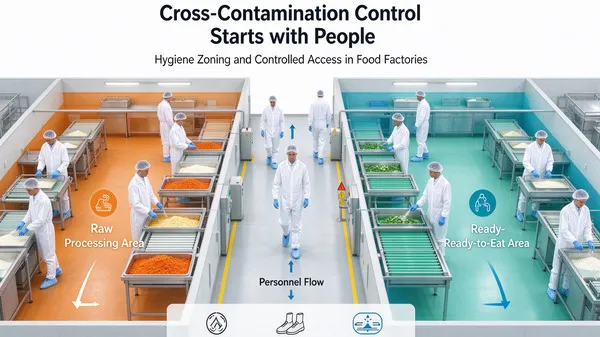
Hygiene Zoning Is a Practical Way to Control Cross-Contamination
One of the most useful concepts for controlling cross-contamination is hygienic zoning.
Instead of treating the entire factory as one environment, the facility is divided according to the level and type of contamination risk.
For example:
Low-risk area → hygiene barrier → higher-risk area
Or:
Raw processing → personnel hygiene → cooked/ready-to-eat processing
The exact zoning depends on the factory and its hazard analysis.
FDA guidance on preventive controls describes hygienic zoning as a way to separate raw, work-in-process, and finished-product operations, as well as personnel and material traffic flows. It also recommends considering the facility structure, personnel movement, ingredient movement, air flow, and crossover areas when establishing the zoning system.
This leads to an important point:
A hygiene station works best when it is part of the zoning design.
Putting a handwashing machine somewhere in the factory does not automatically create a hygiene barrier.
The equipment needs to be positioned where personnel actually cross between different hygiene zones.
Where Should Hygiene Controls Be Installed?
The best location is usually a point where employees must pass before entering a cleaner or higher-risk area.
Typical locations include:
- Production entrances
- High-care area entrances
- Raw-to-clean transitions
- Changing room exits
- Personnel hygiene corridors
- Ready-to-eat production entrances
- Controlled access points
The goal is simple:
Make the correct hygiene process part of the employee’s normal route.
If employees can walk around the station, enter through another door, or bypass the process during busy shift changes, the equipment is no longer functioning as an effective control point.
This is why factory layout matters just as much as the equipment itself.
Why Handwashing and Footwear Cleaning May Need to Work Together
Different factories have different contamination risks.
A bakery may be particularly concerned about personnel hygiene and allergen control.
A meat-processing plant may have much heavier organic contamination around footwear.
A seafood facility may have wet floors and raw product movement.
A ready-to-eat facility may have a much lower tolerance for recontamination after processing.
So there is no reason every factory should use exactly the same hygiene station.
For some entrances, handwashing may be the main requirement.
For others, the process may include:
Handwashing → drying → hand disinfection → footwear cleaning → controlled entry
The equipment should follow the risk rather than the other way around.
Codex guidance recommends handwashing at key moments such as the beginning of food handling, after using the toilet, after breaks, and after handling contaminated material where contamination could be transferred to other food.
For high-risk areas, Codex also highlights the importance of suitable protective clothing and footwear and appropriate measures to prevent personnel from transferring contamination.
A Hygiene Station Should Be Designed Around Employee Flow
One of the easiest mistakes when planning a food factory hygiene system is starting with a product catalogue.
A better starting point is employee flow.
Ask these questions first:
How many people enter at peak time?
The total number of employees is not enough.
If 100 employees work in a factory but most of them enter production gradually throughout the shift, the required capacity may be very different from a factory where 100 employees enter within 10 minutes after a shift change.
Peak flow is what creates queues.
And long queues create another problem: employees may try to skip the process.
Which areas do employees move between?
Map the actual movement:
Changing room → raw area → production → packaging
Then identify where contamination can move with personnel.
What can employees carry?
Look at:
- Hands
- Gloves
- Boots
- Aprons
- Tools
- Equipment
- Waste residues
- Raw material residues
This gives you a much clearer idea of what hygiene controls are actually needed.
What Should You Look for in a Food Factory Hygiene Station?
Once the personnel flow is clear, equipment selection becomes easier.
1. Hands-free operation
Sensors can reduce unnecessary contact with taps, soap dispensers, or other surfaces.
This is particularly useful in busy production environments where many employees use the same station.
2. Stainless steel construction
Food-processing equipment is exposed to water, cleaning chemicals, humidity, and repeated daily use.
Materials and construction should therefore be suitable for the factory’s cleaning and sanitation routine.
3. Easy cleaning
The hygiene station itself should not become another difficult-to-clean object.
Pay attention to:
- Surfaces
- Corners
- Drains
- Pipe connections
- Water accumulation
- Accessibility for cleaning
The basic principle is the same as with other food-processing equipment: the equipment should support cleaning rather than create another sanitation problem.
4. Suitable capacity
A station that is too small for the employee flow can create unnecessary waiting.
For larger production sites, multi-user systems can allow several employees to complete different hygiene steps at the same time.
5. Controlled access
For higher-risk areas, access control can connect hygiene compliance with physical entry.
Instead of:
Wash hands → maybe enter
the process can become:
Complete hygiene process → access released
This does not eliminate the need for supervision and training, but it makes the desired workflow much easier to enforce.
FDA’s review of food-processing practices has also identified automated handwashing systems, sensor-equipped equipment, access-related controls, employee training, and preventing crossover of personnel from raw to finished products among measures used to address employee hygiene and cross-contamination risks.
Hygiene Stations Are Not a Replacement for HACCP
It is important not to overstate what a hygiene station can do.
A hygiene station does not replace:
- HACCP
- GMP
- Cleaning and sanitation programs
- Environmental monitoring
- Employee training
- Hygienic facility design
- Allergen control
- Raw and finished-product segregation
It is one control within the larger food safety system.
FDA HACCP guidance emphasizes traffic control and facility design to minimize cross-contamination, while Codex recommends separating raw and ready-to-eat food and controlling personnel access to higher-risk areas.
The strongest hygiene system is therefore not based on one machine.
It is based on several controls working together.
Example: A Meat Processing Entrance
Consider a meat-processing factory with a raw processing area and a cleaner packaging area.
Without a defined hygiene barrier:
Raw processing → employee → packaging
The employee may carry contamination through footwear, gloves, hands, or protective clothing.
With a controlled personnel route:
Raw processing → footwear cleaning → handwashing → drying → disinfection → controlled entry → packaging
The equipment is only one part of the solution.
The real improvement comes from changing the movement of people between the two zones.
This is also why FDA materials discuss preventing personnel crossover from raw areas to finished-product areas as part of food-processing controls.
Different Food Factories Need Different Hygiene Controls
There is no universal setup.
| Factory Type | Common Personnel Hygiene Concern | Possible Control |
|---|---|---|
| Meat processing | Organic residues and raw-product contamination | Hand + footwear hygiene |
| Seafood processing | Wet environments and raw-product handling | Hand + footwear hygiene |
| Bakery | Personnel movement and allergen control | Hand hygiene + zoning |
| Dairy | Wet processing and personnel movement | Hand + footwear control |
| Ready-to-eat food | Recontamination after processing | Strict personnel hygiene + controlled access |
| Central kitchen | Frequent movement between preparation areas | Hand hygiene + zoning |
These are starting points rather than fixed specifications. The actual system should be based on the factory’s products, layout, hazard analysis, and employee traffic.
How WONE Approaches Personnel Hygiene
At WONE, we focus on equipment for personnel hygiene, equipment cleaning and hygiene, and air disinfection in food-processing environments.
For personnel entrances, the equipment can be configured around the actual hygiene process required by the factory.
Depending on the application, this can include:
- Automatic handwashing
- Hand drying
- Hand disinfection
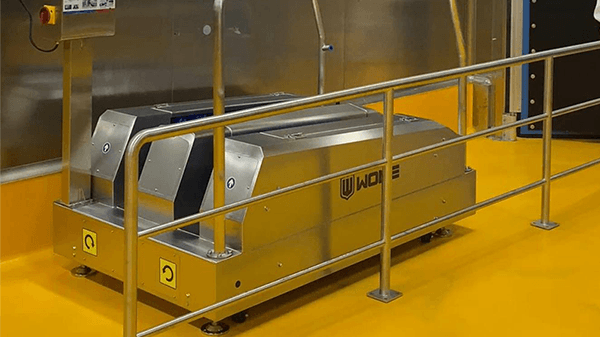
- Sole cleaning
- Boot cleaning
- Personnel access control
- Sensor-based operation
- Hygiene process monitoring
For example, a multi-user handwashing and drying station can help handle higher personnel flow, while stations combining hand hygiene with sole cleaning can address both hand and footwear contamination at the same entrance.
For a heavy-duty environment such as meat or slaughter processing, a full boot-washing system may make more sense than a simple sole-cleaning unit.
The point is not to install the most complicated system.
The point is to match the hygiene control to the contamination risk.
A Simple Way to Evaluate Your Factory
Before selecting equipment, walk through the factory with one question:
“If an employee walks from Area A to Area B, what could they carry with them?”
Then check:
- Where are the raw and clean areas?
- Where do employees change clothing?
- Where do they wash their hands?
- Where do they clean or change footwear?
- Which entrances are controlled?
- How many employees pass through each entrance?
- What happens during shift changes?
- Can employees bypass the hygiene process?
- Does the equipment match the cleaning environment?
- Can the hygiene process be monitored?
These questions usually reveal more than simply asking which hygiene station has the most functions.
Final Takeaway
Preventing cross-contamination in food factories is not only about cleaning the production line.
It is also about controlling how people move through the factory.
Hands, footwear, protective clothing, tools, and contact surfaces can all become part of the contamination pathway. Food safety guidance from Codex and FDA therefore places significant attention on personnel hygiene, traffic flow, hygienic zoning, separation of raw and finished-product areas, and controlled access.
A hygiene station can help turn these principles into a practical process at the entrance to a production area.
But the right solution depends on the factory.
Start with the contamination risk.
Map the personnel flow.
Identify the hygiene zones.
Then choose the equipment that makes the required process easier to follow every day.
That is how a hygiene station becomes more than a washing point — it becomes part of the factory’s cross-contamination control system.
FAQ
How do hygiene stations prevent cross-contamination?
They create a controlled point where employees can complete required hygiene steps before moving from one production zone to another. Depending on the factory, this may include handwashing, drying, hand disinfection, footwear cleaning, and controlled access.
Are hygiene stations required in every food factory?
The exact equipment and layout depend on the facility, products, hazards, and applicable regulations. Food safety guidance generally emphasizes personnel hygiene, separation of higher- and lower-risk areas, and appropriate controls for personnel movement rather than requiring one identical type of station for every factory.
Is handwashing enough to prevent cross-contamination?
Not always. Hands are an important contamination route, but footwear, clothing, tools, equipment, and personnel movement can also transfer contamination. The appropriate controls depend on the factory’s risk assessment.
Where should a hygiene station be installed?
It is generally most useful at a point where employees must pass between different hygiene zones, such as a production entrance, changing-room exit, or high-risk area entrance.
How do I choose a hygiene station for a food processing plant?
Start with employee flow, hygiene zoning, contamination risks, peak personnel traffic, cleaning conditions, and the specific hygiene steps required. Then select the equipment and capacity that fit the process.