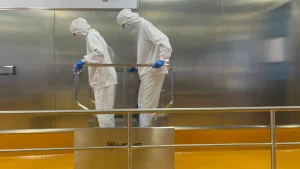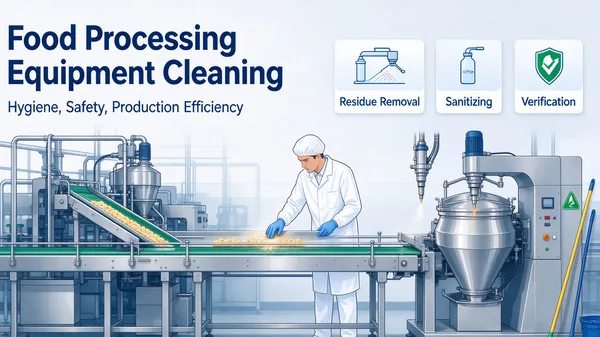
Food equipment cleaning is essential for food manufacturers to maintain hygiene, prevent cross-contamination and keep production running efficiently. From removing food residues to cleaning and sanitizing machinery, every step should match the type of food processed, the equipment design and the factory’s hygiene requirements.
Why Proper Food Processing Equipment Cleaning Matters
Food residues can remain on conveyor belts, mixing equipment, filling machines, cutting tools and other hard-to-reach surfaces. If cleaning is incomplete, these residues can create conditions that compromise food hygiene.
The USDA Food Safety and Inspection Service explains that food-contact surfaces must be cleaned and sanitized as frequently as necessary to prevent insanitary conditions or food adulteration.
The FDA’s food safety guidance also highlights the importance of effective cleaning in reducing allergen cross-contact. Its research found that the nature of the residue, the surface material and the cleaning method can all affect removal.
For factory managers, this means that a surface that looks clean is not necessarily proof that the cleaning process is effective.
A reliable program needs defined procedures, suitable cleaning chemicals, trained operators and a way to verify results.
How to Clean Food Processing Equipment Step by Step
Step 1: Stop Production and Remove Food Residues
Stop the equipment and follow the manufacturer’s lockout and safety procedures before cleaning. Remove exposed food products from the cleaning area and protect any equipment or materials that must remain in place.
Scrape or collect loose food residues before applying water. Use designated tools to remove dough, meat particles, fat, cheese residues or other product buildup.
This step is easy to underestimate. If large amounts of food residue are washed directly into drains, they can increase wastewater loading and make the cleaning area harder to manage.
For dry-processing operations, such as flour handling, use a suitable dry-cleaning method and appropriate dust controls before introducing water. Wet cleaning is not suitable for every product or every piece of equipment.
Practical tip: Identify the type of residue before choosing a cleaning method. Dry flour, sticky sugar, protein deposits and heavy grease do not respond to identical cleaning procedures.
Step 2: Disassemble Equipment Where Necessary
Open or disassemble the parts specified in the equipment manufacturer’s cleaning instructions.
Pay particular attention to:
- Conveyor belt joints and undersides
- Gaskets, seals and removable fittings
- Mixing blades and food-contact components
- Filling nozzles and product transfer points
- Areas around machine frames where residues can accumulate
Not every machine needs to be completely dismantled after every shift. The correct scope depends on its design, the product being processed, the contamination risk and the validated cleaning procedure.
The goal is to make all relevant surfaces accessible without damaging components or creating new contamination risks during reassembly.
Step 3: Pre-Rinse When the Cleaning Procedure Requires It
For suitable wet-cleaning operations, rinse equipment with water at a temperature and pressure appropriate for the residue, equipment and cleaning chemicals.
The purpose is to remove loose soil before detergent is applied.
Avoid assuming that higher water pressure always produces better results. Excessive pressure can spread contamination through splashing or aerosols, damage sensitive components and force water into areas that are difficult to dry.
Water temperature also matters. For example, unsuitable temperatures can make certain protein residues more difficult to remove.
Follow the equipment manufacturer’s instructions and the site’s approved sanitation procedure rather than applying one setting to every production line.
Step 4: Apply the Correct Detergent
Detergent helps loosen and remove residues that water alone may not remove effectively.
Select the detergent according to the soil type, surface material, water conditions and cleaning method. Always follow the chemical supplier’s instructions for concentration, temperature, contact time and compatibility.
Common considerations include:
- Fat and grease: A suitable alkaline detergent may help break down fatty residues.
- Protein residues: Use a detergent and temperature range appropriate for the specific protein soil.
- Mineral deposits: An approved acidic cleaner may be needed for certain scale deposits.
- Mixed food residues: A planned combination of cleaning stages may be more effective than simply increasing detergent concentration.
Foam cleaning can be useful on accessible equipment surfaces, machine frames, walls and floors. Foam helps distribute detergent across a surface and makes coverage easier for operators to inspect.
However, foam is not a substitute for correct chemical concentration, contact time, mechanical action or rinsing. It also cannot guarantee effective cleaning inside enclosed pipes or inaccessible machine components.
For larger facilities, an industrial foam cleaning system can help standardize detergent application across designated cleaning areas.
Step 5: Brush Difficult Areas and Rinse Thoroughly
After the required detergent contact time, use suitable brushes or other approved mechanical action on areas where residues remain.
Focus on joints, corners, belt edges, textured surfaces and other locations that are difficult to clean with spraying alone.
Then rinse as required by the cleaning procedure to remove loosened soil and detergent residues.
Use brushes and tools assigned to the correct hygiene zones. A tool used on floors should not be reused on food-contact surfaces without an approved cleaning and sanitation process.
Inspect the equipment before moving to the next stage. If visible residues remain, repeat the appropriate cleaning step instead of relying on sanitizing chemicals to compensate for incomplete cleaning.
Step 6: Sanitize the Equipment
Cleaning and sanitizing are different operations.
Cleaning removes food residues, dirt and other unwanted material. Sanitizing applies a validated treatment to reduce microorganisms on suitable surfaces to the required level.
After cleaning and rinsing where required, apply an approved sanitizer according to its label and the facility’s sanitation procedure.
Control the factors that affect performance, including:
- Sanitizer concentration
- Contact time
- Temperature and pH, where relevant
- Surface coverage
- Compatibility with the equipment and product
- Whether rinsing is required by the chemical label or applicable rules
Do not assume that a stronger solution is automatically better. Excessive concentrations can create chemical safety issues, damage equipment or leave unacceptable residues.
The FDA Food Code provides specific sanitizing requirements for the food establishments covered by that code. Industrial food manufacturers must also follow the regulations and validated procedures applicable to their operation and location.
Important: Sanitizing should not begin until the preceding cleaning steps have adequately removed soil. Organic residues can interfere with the effectiveness of some sanitizers.
Step 7: Allow Equipment to Drain and Dry
Follow the approved procedure for draining and drying equipment before production resumes.
Standing water can create problems around machine bases, hollow structures, joints and areas that are difficult to inspect. Use the drying method specified for the equipment and environment.
Where compressed air is used, ensure it is suitable for the application and will not introduce oil, moisture or other contaminants.
Check removable parts before reassembly. Make sure they are clean, appropriately dried where required and installed correctly.
Step 8: Inspect and Verify Cleaning Results
Before restarting production, inspect the equipment according to the plant’s pre-operational checklist.
A practical verification program may include:
- Visual inspection: Check for visible food residues, grease, detergent deposits and standing water.
- ATP testing: Use where appropriate as a rapid indicator of residual biological material. ATP results do not identify specific pathogens.
- Microbiological testing: Use risk-based sampling when required to assess microbial conditions.
- Chemical checks: Verify sanitizer concentration or other relevant process parameters using suitable methods.
- Documentation: Record completion, inspection results, deviations and corrective actions.
A visual inspection alone cannot establish that a surface is microbiologically safe. Likewise, one negative swab does not prove that every part of a production line is clean.
The purpose is to combine suitable checks with a cleaning procedure that has been established and verified for the actual equipment and production conditions.
How Long Should It Take to Clean Food Processing Equipment?
There is no reliable universal cleaning time for every food factory.
The time required depends on the product, soil load, equipment design, production volume, dismantling requirements, cleaning chemicals, water supply and the number of trained sanitation workers.
A useful way to assess cleaning performance is to measure each stage separately.
| Cleaning stage | What to measure |
|---|---|
| Preparation | Time to stop, isolate and prepare equipment |
| Residue removal | Time spent scraping and collecting food residues |
| Detergent application | Application time and required contact time |
| Mechanical cleaning | Brushing and removal of stubborn residues |
| Rinsing and sanitizing | Process time and chemical contact time |
| Inspection and reassembly | Verification, corrective work and readiness for production |
Compare the same equipment and similar production conditions across several cleaning cycles. Record both total sanitation time and the number of times operators must repeat a cleaning step.
This distinction matters: a shorter cleaning cycle is not necessarily a better one if it results in repeat cleaning, failed verification or production delays.
For factory managers, the most useful performance indicator is not simply minutes spent cleaning. It is the time needed to achieve a verified, repeatable result.
Common Food Processing Equipment Cleaning Mistakes
Using Water Pressure as the Main Cleaning Strategy
High-pressure cleaning can help remove certain residues, but pressure alone does not determine cleaning effectiveness. Soil type, detergent, contact time, surface accessibility and operator technique all matter.
Applying Sanitizer Before Removing Soil
Sanitizer is not designed to replace detergent cleaning. Residues left on the surface may interfere with the sanitation step.
Ignoring Equipment Design
Dead ends, damaged seals, poorly accessible joints and areas that retain water can make consistent cleaning difficult. Persistent cleaning problems may require maintenance or a design change rather than more labor.
Using the Same Method for Every Production Area
A bakery, dairy plant, meat processor and dry ingredient facility can have very different cleaning requirements. Procedures should reflect the actual process and contamination risks.
Failing to Record Results
Without records, managers may struggle to identify recurring problem areas, compare cleaning shifts or determine why a line repeatedly fails inspection.
How to Choose the Right Industrial Cleaning Equipment
The best cleaning equipment depends on the facility’s sanitation method and the surfaces being cleaned. Buying a more powerful machine without reviewing the cleaning process can add cost without solving the underlying problem.
Consider these factors before investing:
1. Type of food residue
Heavy grease, protein, dough and dry powder require different cleaning approaches. Identify the dominant soil and any secondary residues before choosing equipment.
2. Production area and equipment layout
Large open surfaces may benefit from a mobile foam cleaning system. Equipment with enclosed product pathways may require dedicated cleaning procedures or clean-in-place systems.
3. Cleaning frequency and labor
If operators repeatedly mix chemicals manually or use inconsistent application methods, a suitable foam or chemical-dosing system may help standardize the process.
4. Water supply and drainage
Check water pressure, flow, drainage capacity and wastewater handling. Cleaning equipment should suit the site’s actual utilities and operating conditions.
5. Chemical compatibility and verification
Confirm that the equipment is compatible with the intended chemicals and that operators can follow the required concentration, contact time and rinsing procedure.
For facilities that rely on manual cleaning across large production areas, an industrial foam cleaning system may be worth evaluating alongside existing hoses, brushes and pressure-cleaning equipment.
The decision should be based on cleaning performance, labor requirements, water and chemical use, maintenance and the ability to achieve consistent results—not just the purchase price.
Build a Repeatable Cleaning Process, Not Just a Cleaning Checklist
A checklist is useful only when it reflects the real conditions of the production line.
The FAO’s Good Hygiene Practices and HACCP guidance emphasizes appropriate cleaning, maintenance and procedures to help control contamination risks.
For a food processing plant, a practical sanitation program should define:
- Which equipment and surfaces must be cleaned
- Who is responsible for each task
- Which tools, chemicals and methods are approved
- How often cleaning must take place
- What conditions must be met before production restarts
- How cleaning effectiveness is monitored
- What corrective action is required when results are unacceptable
Review the program whenever the product, production process, equipment or contamination risks change.
This is where cleaning becomes an operational control rather than simply an end-of-shift task.
Final Thoughts
Effective food processing equipment cleaning depends on more than removing visible dirt. It requires the right sequence of residue removal, detergent application, rinsing, sanitizing, drying and verification.
For plant managers, the real opportunity is to make that process repeatable across shifts while reducing unnecessary rework and protecting production readiness.
If your factory is reviewing its sanitation process, start by identifying the equipment that takes the longest to clean, the areas that repeatedly fail inspection and the steps that vary most between operators. Those findings provide a stronger basis for selecting cleaning equipment than purchasing machinery first and adapting the procedure later.
Looking for industrial foam cleaning equipment for your food processing plant? WONE Clean provides cleaning equipment for food industry applications. Contact our team to discuss your production area, cleaning requirements and suitable equipment options.