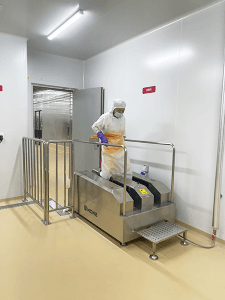
Airborne microorganisms are an often-overlooked hygiene risk in food processing plants.
Yeast, mold and bacteria can spread through air movement, personnel traffic, condensation and poorly maintained ventilation systems. In areas where products are exposed after cooking or during cooling and packaging, poor air hygiene can increase the risk of product contamination and shorten shelf life.
So, how can food manufacturers control airborne microbial contamination?
The answer is not simply “use more disinfectant.” A reliable solution combines ventilation, humidity control, cleaning, environmental monitoring and air disinfection.
1. Where Do Airborne Microorganisms Come From?
Several factors can increase microbial loads in food production areas:
Poor airflow
Air should generally move from cleaner areas toward less-clean areas, rather than carrying contaminants into high-hygiene zones.
Air intakes should also be positioned away from potential contamination sources such as waste areas, exhaust outlets and wastewater facilities.
High humidity and condensation
Moist environments can create favorable conditions for mold and other microorganisms.
Condensation on ceilings, pipes, equipment or cooling surfaces should be treated as a hygiene warning sign—not just a maintenance problem.
Poor ventilation maintenance
Dirty filters, air-handling units, ducts and return-air grilles can accumulate dust and organic matter.
If these components are not regularly inspected and maintained, the ventilation system may contribute to environmental contamination instead of controlling it.
Insufficient environmental disinfection
Traditional cleaning and surface disinfection cannot completely address airborne contamination.
This is particularly important in:
- Cooling rooms
- Internal packaging rooms
- Ready-to-eat food areas
- Bakeries
- Meat processing plants
- Dairy production areas
2. Monitor Before You Change the Disinfection Strategy
When microbial results increase, the first step should be investigation.
A practical monitoring program can include:
- Airborne microbial counts
- Yeast and mold testing where relevant
- Surface swab testing
- Temperature and humidity records
- Ventilation and filter inspections
- Microbial trends over time
Sampling should focus on areas where products are exposed or where contamination could directly affect product safety.
Instead of reacting to one test result, look for trends.
For example, if microbial counts repeatedly increase after several hours of production, personnel movement, airflow or humidity may need to be investigated.
3. Use Different Air Disinfection Methods for Different Conditions
There is no single air disinfection method that fits every food factory.
During production: enclosed UV air treatment
An enclosed UV air disinfection system can continuously circulate room air through an internal UV chamber.
Because the UV source is enclosed inside the equipment, properly designed systems can operate while people are working in the room.
This makes UV air treatment useful for reducing airborne microbial loads during production.
After production: ozone treatment
Ozone can be used for whole-room treatment when the production area is unoccupied.
Unlike direct UV exposure, ozone can spread throughout an enclosed room and reach areas that are difficult to treat with line-of-sight disinfection.
However, ozone treatment must be properly controlled. The area should be unoccupied during treatment and safely ventilated before personnel return.
UV during production + ozone after production can therefore provide two different layers of environmental control.
4. How Effective Is Air Disinfection?
Air disinfection should always be verified through monitoring rather than assumed to work simply because a machine is installed.
According to the U.S. EPA, UVGI systems can be used as an engineering control to reduce airborne microorganisms when properly designed and maintained. The effectiveness depends on factors including UV dose, airflow, exposure time and system design.
The same principle applies to food factories:
Install → Operate → Monitor → Verify → Adjust
If microbial counts remain high, check the root cause before simply increasing treatment time.
The problem may actually be condensation, poor airflow, dirty filters, personnel movement or inadequate cleaning.
5. WONE UV + Ozone Air Disinfection Systems
WONE Clean provides air disinfection equipment for food processing environments, including UV + ozone systems designed for different room sizes and installation requirements.
The equipment can be used in areas such as:
- Food processing rooms
- Cooling rooms
- Packaging rooms
- Changing rooms
- Bakeries
- Meat processing plants
- Dairy facilities
WONE’s AUT-200&300 series, for example, combines UV and ozone functions for controlled air treatment. The models are designed for approximately 200 m² and 300 m² applications, depending on actual room conditions and installation requirements.
Explore WONE Air Disinfection Machines
Conclusion
Airborne microbial control is not just an air disinfection problem.
A stable food hygiene program should control the entire environment:
Airflow + Humidity + Cleaning + Monitoring + Air Disinfection
If your food processing plant is experiencing recurring mold, yeast or airborne microbial problems, start by identifying the source and monitoring the trend.
Then select the appropriate combination of ventilation, sanitation and air treatment.
Better air hygiene means better control of the production environment—and more consistent food quality.
Sources
- U.S. EPA — Ultraviolet Germicidal Irradiation (UVGI)
- U.S. FDA — Current Good Manufacturing Practices for Food
- CDC/NIOSH — Ventilation and Indoor Air Quality