Food processing hygiene is changing in 2026. Food manufacturers are moving beyond routine cleaning schedules and focusing more on contamination prevention, personnel hygiene, verification, and smarter sanitation systems.
For years, many factories measured sanitation performance by a familiar list: cleaning completed, chemicals applied, equipment rinsed, and production restarted. That approach still has its place, but it no longer tells the whole story.
A modern food factory has to answer a harder question: where can contamination enter, move, survive, and spread during production?
That shift is shaping food processing hygiene in 2026. Cleaning is becoming more risk-based, personnel hygiene is moving closer to the center of food safety management, and digital equipment is making hygiene procedures easier to control and verify.
For food manufacturers, those numbers translate into a practical priority: contamination needs to be prevented before it reaches the product.
1. Cleaning Is No Longer Just a Scheduled Task
A factory may have a cleaning schedule covering every production area, yet still have hygiene problems.
The reason is that contamination does not follow a timetable.
Protein residues around cutting equipment, fat on processing surfaces, starch deposits in bakery production, or milk residues in dairy equipment can behave very differently. Their removal depends on the soil itself, the surface, detergent concentration, temperature, mechanical action, and contact time.
In practice, this means a better sanitation program starts with risk and soil type, rather than simply asking how often an area should be cleaned.
The basic principle is straightforward: cleaning removes soil and organic matter; sanitization or disinfection then reduces microorganisms to the required level. If organic residues remain, the subsequent disinfection step may not perform as intended.
That is why food factories are paying more attention to the complete cleaning process instead of focusing only on the final disinfectant.
Foam cleaning is a good example
Foam cleaning equipment allows operators to cover large surfaces with detergent foam and maintain visible contact with the surface before rinsing.
For a busy processing plant, that visibility matters. Operators can see whether walls, floors, conveyors, and equipment have actually been covered instead of relying on an approximate amount of detergent poured from a container.
More importantly, controlled application can make cleaning more repeatable between different operators and production shifts.
The objective is not to use more detergent or water. It is to achieve the required cleaning result with better control.
2. Personnel Hygiene Is Becoming a Production-Control Issue
When contamination enters a production area, the source is not always the processing equipment.
Employees can transfer microorganisms through hands, gloves, footwear, clothing, and contact with shared surfaces. Footwear deserves particular attention because workers can carry contamination from floors and lower-risk areas directly into higher-hygiene zones.
This is where personnel hygiene equipment becomes more than an employee convenience.
A properly designed hygiene entrance can combine:
- Automatic hand washing
- Soap dispensing
- Hand disinfection
- Hand drying
- Boot or shoe sole cleaning
- Boot sole disinfection
- Access control
- Hygiene process monitoring
The important point is process control.
If an employee can walk directly from a production floor into a high-care area, the factory is relying heavily on individual behavior. During a normal shift, especially when production is under pressure, that creates unnecessary variation.
A controlled hygiene entrance creates a physical barrier between zones.
For example, an access system can require employees to complete designated hand and footwear hygiene steps before the gate opens. As a result, the factory does not have to depend entirely on supervisors watching every employee entering the production area.
This is one reason integrated hygiene stations are becoming increasingly relevant in high-hygiene food production.
3. “We Cleaned It” Is Not the Same as “We Verified It”
One of the most important changes in food processing hygiene is the growing importance of verification.
A completed cleaning checklist proves that someone recorded a cleaning activity. It does not automatically prove that the surface was hygienically clean.
That distinction is critical.
Factories increasingly use tools such as:
- ATP testing
- Environmental microbiological monitoring
- Visual inspection
- Chemical concentration checks
- Temperature monitoring
- Digital cleaning records
These methods provide evidence that can be compared over time.
Suppose an ATP result repeatedly increases around the same piece of equipment after night-shift cleaning. The useful question is not simply whether the operator completed the checklist. Instead, the QA team can investigate the cleaning method, equipment design, access points, detergent application, or operator training.
In other words, verification turns hygiene from a routine activity into a continuous improvement process.
The same principle applies to personnel hygiene.
Digital hygiene systems can record access events, operating cycles, alarms, and other information. Consequently, managers can identify recurring problems instead of relying solely on manual observation.
4. Cross-Contamination Is a Movement Problem
A common mistake is to look at contamination as a surface-cleaning issue only.
In reality, contamination can move through the factory.
An employee walks from a raw material area to a processing room. A trolley crosses two hygiene zones. A boot carries residue from one floor to another. A cleaning tool is used in a lower-risk area and then taken into a high-care room.
None of these events necessarily looks serious by itself.
Together, however, they can create a contamination pathway.
That is why hygiene zoning and movement control are becoming increasingly important.
A factory may separate raw material, processing, high-care, ready-to-eat, packaging, and waste-handling areas. Each zone should have clearly defined rules for people, footwear, equipment, tools, and materials.
Personnel hygiene equipment supports this strategy by creating controlled transition points.
For instance, a boot washer at the entrance to a high-hygiene zone addresses a very different risk from a general floor-cleaning machine. One is controlling a contamination pathway; the other is cleaning the production environment.
The distinction is important when deciding where to invest in hygiene equipment.
5. Automation Should Reduce Variation, Not Just Add Technology
“Smart hygiene” is another major theme in 2026, but automation by itself does not make a factory more hygienic.
The real value comes from reducing process variation.
Consider two employees using the same manual cleaning method. One applies enough detergent and allows sufficient contact time. The other uses less chemical and rinses almost immediately because production needs to restart.
The written SOP is identical. The actual hygiene result may not be.
Automation can help narrow this gap.
Depending on the application, modern hygiene systems can control or monitor:
- Chemical dosing
- Cleaning cycles
- Water usage
- Access permissions
- Disinfection procedures
- Equipment status
- Low-liquid alarms
- Hygiene records
For personnel entrances, automatic sensors and access control can also help ensure that required hygiene steps are completed before entry.
That does not eliminate the need for trained employees. Instead, it gives employees a more consistent system to work with.
Good automation removes avoidable variation. It should not create unnecessary complexity.
6. Water and Chemical Efficiency Are Becoming Hygiene KPIs
Food factories consume substantial amounts of water during cleaning. At the same time, detergents and disinfectants represent a significant operating cost for facilities with frequent sanitation cycles.
As a result, hygiene managers are under pressure to improve efficiency without compromising food safety.
The wrong response is simply to reduce chemical concentration or shorten cleaning time.
A better approach is to examine the entire cleaning cycle:
Chemical concentration + coverage + contact time + mechanical action + temperature + rinsing
Changing one factor can affect the others.
For example, better foam coverage may improve detergent contact across a large surface. More consistent dosing can reduce the risk of both under-dosing and unnecessary chemical use. Improved equipment design can also reduce the amount of water needed for certain cleaning tasks.
Therefore, the question for 2026 is not:
“How can we use less water?”
It is:
“How can we remove the same contamination with less waste?”
That is a much more useful efficiency target.
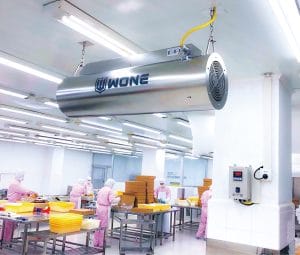
7. Air Hygiene Deserves More Attention in High-Care Production
Food factories often focus heavily on surfaces while giving less attention to the production environment itself.
For sensitive products, however, air movement, condensation, humidity, ventilation, and airborne particles can all influence environmental hygiene.
This is particularly relevant in ready-to-eat food production, dairy processing, bakery production, beverage facilities, and other environments where the product may receive little or no further microbial reduction after the final processing stage.
Air disinfection technologies can therefore be considered as part of a broader environmental control strategy.
They should not replace ventilation, cleaning, filtration, or proper zoning. Instead, they can support an existing hygiene program when the risk assessment shows that additional air control is appropriate.
More importantly, factories should first understand where airborne contamination could affect the product before selecting an air treatment technology.
Technology should follow the risk assessment, not the other way around.
8. The Next Step Is Connecting Hygiene Systems
The most interesting development in food processing hygiene is not one particular machine.
It is the connection between different hygiene controls.
Consider a production entrance:
Employee arrives
↓
Hand washing
↓
Hand disinfection
↓
Boot cleaning and disinfection
↓
Access verification
↓
Entry into controlled production zone
Now connect that with the production side:
Production ends
↓
Foam cleaning
↓
Rinsing
↓
Disinfection
↓
Environmental verification
↓
Digital record
The factory begins to move from isolated hygiene tasks toward a connected contamination-control system.
That is a significant difference.
Instead of asking whether a machine is working, managers can ask whether the overall hygiene barrier is working.
What Should Food Factories Review in 2026?
A useful starting point is to walk through the factory and ask five questions.
1. Where can contamination enter?
Look beyond raw materials. Consider employees, footwear, tools, equipment, water, air, and traffic between zones.
2. Where can contamination accumulate?
Check difficult-to-clean equipment, joints, drains, floors, conveyors, processing lines, and areas exposed to grease or protein residues.
3. Where can contamination move?
Map the movement of employees, footwear, equipment, waste, raw materials, and finished products.
4. How do we know cleaning worked?
Review ATP, microbiological monitoring, chemical checks, visual inspection, and other verification methods.
5. Which hygiene steps depend too heavily on human memory?
If a critical step is frequently skipped, consider whether equipment, access control, sensors, or process redesign could make compliance easier.
These questions often reveal more than simply checking whether every cleaning task on the daily schedule has been ticked off.
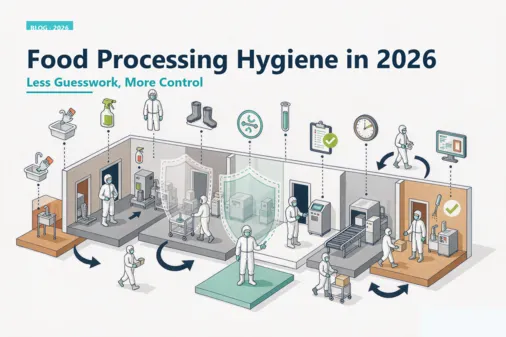
Food Processing Hygiene in 2026: Less Guesswork, More Control
The food industry is not moving toward “more cleaning” for its own sake.
It is moving toward more controlled cleaning.
The difference matters.
A strong hygiene program connects risk assessment, personnel hygiene, cleaning, disinfection, environmental monitoring, zoning, verification, and data. When these elements support each other, factories can respond to contamination risks earlier and make sanitation performance more consistent.
For food manufacturers, the practical goal is clear:
Prevent contamination where it starts, stop it from moving, and verify that the controls are working.
At Woneclean, we develop hygiene equipment for food processing environments, including personnel hygiene stations, boot cleaning and disinfection systems, foam cleaning equipment, and air disinfection solutions.
The right solution depends on the factory layout, production process, employee flow, hygiene zoning, and specific contamination risks.
In 2026, the strongest food processing hygiene strategy is not simply about having more equipment.
It is about building a hygiene system that works consistently—even when production is busy.