Introduction
In food processing plants, work boots are exposed to water, cleaning chemicals, grease, blood, food residues, and wastewater. Washing boots is an important part of footwear hygiene, but what happens after washing deserves just as much attention.
Boots may remain damp inside even when their outer surfaces look dry. If employees leave wet boots on the floor or store them in poorly ventilated areas, moisture can build up in the changing room. Workers may also have to put on damp footwear at the beginning of their next shift.
An industrial boot dryer provides a more organized way to dry and store work boots between uses. However, choosing the right equipment involves more than checking how many pairs it can hold.
Drying capacity, shift schedules, boot design, available space, and the factory’s cleaning procedures all affect whether a boot drying system works well in daily operations.
This guide explains what food manufacturers should consider before installing a boot dryer.
1. Why Wet Boots Are a Practical Problem in Food Factories
Work boots are regularly exposed to moisture in meat processing plants, seafood factories, slaughterhouses, dairy facilities, and other wet production environments.
The challenge often starts after cleaning.
Moisture inside tall boots
Water can remain around the toe, in the footbed, or inside the shaft of tall rubber boots. Simply placing boots upside down or leaving them on a rack may not provide consistent drying conditions.
Poor storage conditions
When wet boots are placed close together or stored in enclosed spaces without sufficient airflow, drying can take longer. The changing room may also become harder to keep clean and orderly.
Different results between shifts
One employee may clean and store footwear immediately, while another leaves it wet until the next shift. Without a defined process, drying results can vary across the workforce.
The practical issue is not simply whether boots are washed. It is whether cleaned footwear is ready for its next use.
A dedicated drying area helps factories establish a more consistent routine.
2. What Does an Industrial Boot Dryer Actually Do?
An industrial boot dryer is designed to remove moisture from work boots after use or cleaning.
Many systems use forced air, with some models incorporating heated air to support drying. Depending on the design, drying tubes may direct air into individual boots, while cabinet-style units provide enclosed storage and drying.
Some industrial boot dryers also offer an additional deodorization or disinfection function.
These functions should be evaluated separately:
- Cleaning: Removes dirt, grease, and food residues from footwear.
- Disinfection: Reduces microorganisms when the method and operating conditions are appropriate.
- Drying: Removes moisture from the footwear.
- Storage: Keeps boots organized between uses.
A drying cycle alone does not prove that boots have been disinfected. Likewise, adding an ozone function does not automatically establish a particular level of microbial reduction. Any disinfection claim should be supported by the equipment specifications and appropriate validation.
For most food factories, the first step is to define the required process and then select equipment that fits it.
3. How Much Boot Drying Capacity Does Your Factory Need?
Capacity is one of the most important considerations when selecting an industrial boot dryer. However, the number of drying positions should not be considered in isolation.
A factory with 100 employees working across several shifts has different requirements from a facility where a small team uses the same boots throughout the day.
Start with three questions:
- How many pairs need drying during the busiest period?
- How much time is available before the next use?
- Can boots remain in the dryer while employees are working?
A simple capacity calculation
Consider a factory that needs to dry 40 pairs of boots within a two-hour period.
The required average throughput is:
40 pairs ÷ 2 hours = 20 pairs per hour
Now consider a dryer that holds 20 pairs per cycle.
These figures are mathematical examples, not guaranteed machine performance. They assume that a new batch can start immediately after the previous cycle and exclude loading, unloading, and other delays.
Actual drying times depend on the boot material, initial moisture level, air temperature, airflow, and boot design.
For this reason, ask suppliers for verified drying performance under conditions similar to your factory’s operation.
4. Choosing Between a Boot Drying Rack and a Drying Cabinet
The equipment format should match the factory’s available space and storage routine.
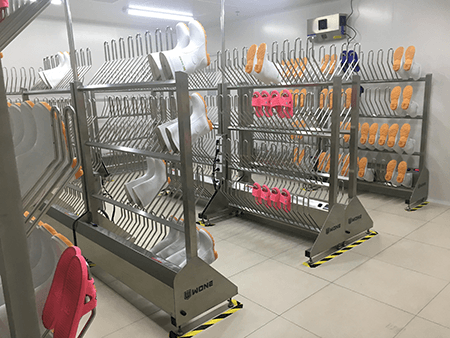
Boot drying rack
A rack with drying tubes provides individual positions for footwear and can make loading and unloading straightforward. It may be suitable for changing rooms where open access is preferred.
For example, WONE’s PBD-10E boot dryer has a listed capacity of 12 pairs and uses a stainless-steel structure. Its specified functions include hot-air drying and ozone treatment.
Boot drying cabinet
A cabinet-style dryer provides an enclosed arrangement for drying and storing boots. This format may suit facilities that prefer a more contained storage area.
WONE’s PBD-20C boot dryer cabinet has a listed capacity of 20 pairs, with hot-air drying and ozone treatment.
These are examples of different equipment formats, not a universal ranking. The appropriate choice depends on the factory’s workflow, available installation space, required capacity, and maintenance preferences.

5. Where Should an Industrial Boot Dryer Be Installed?
The location of the dryer affects how easily employees follow the footwear hygiene procedure.
A useful starting point is to map the movement of employees and boots through the changing room.
For example:
Remove or change footwear → Clean boots when required → Disinfect according to procedure → Dry → Store
The exact sequence depends on the factory’s hygiene requirements and the footwear involved.
A few practical points deserve attention:
- Keep the drying area separate from locations where heavily soiled footwear is handled, where the layout permits.
- Provide enough space for employees to load and unload boots without blocking walkways.
- Make sure the equipment can be cleaned and maintained without disrupting personnel movement.
- Consider electrical access, ventilation, and the surrounding wet-cleaning environment.
- Avoid placing clean, dry footwear back into an area where it can immediately become contaminated.
For factories with separate raw-material and high-hygiene areas, the changing room layout should also support the required movement between hygiene zones.
A boot dryer should fit into this workflow rather than become an isolated piece of equipment.
For more information on planning the wider area, see our guide to changing room equipment for food and beverage factories.
6. What Should Buyers Check Before Purchasing?
A suitable industrial boot dryer should meet the factory’s operating requirements and be practical to maintain.
Use the following checklist when comparing equipment.
Capacity and boot compatibility
Confirm the number of pairs that can be handled per cycle. Check whether the drying positions accommodate the height, shape, and size of the boots used by employees.
Drying performance
Ask how drying performance is measured and whether the recommended cycle has been tested with similar footwear.
Material and cleanability
Stainless steel is commonly used for equipment in wet industrial environments. Check the grade, construction, accessible surfaces, and manufacturer’s cleaning instructions rather than relying on the material name alone.
Controls and operating schedules
Timer settings can help standardize drying periods and schedule operation around shift changes. Confirm which settings are available on the selected model.
7. A Boot Dryer Is Only One Part of Footwear Hygiene
One common mistake is expecting a drying machine to solve every footwear hygiene problem.
Drying does not remove heavy grease or food residues. It also does not replace a required cleaning or disinfection procedure.
In a food processing plant, the footwear process should be designed around the actual contamination risks and personnel flow.
For example, boots used in meat processing may need thorough removal of blood, fat, and organic residues before disinfection. Footwear used in seafood production may require attention to fish residues, slime, and wet working conditions.
The correct procedure depends on the operation and its hygiene requirements.
A more useful way to evaluate the system is to ask four questions:
- Are visible soils removed effectively?
- Is any required disinfection step carried out under suitable conditions?
- Are boots sufficiently dry before their next use?
- Are clean boots stored in a way that prevents recontamination?
If one of these steps is overlooked, installing a larger dryer may not solve the underlying problem.
8. Suitable for Different Food Processing Environments
Industrial boot dryers can be used in a wide range of food processing plants, wherever employees wear work boots that need to be dried after use or cleaning.
Typical applications include:
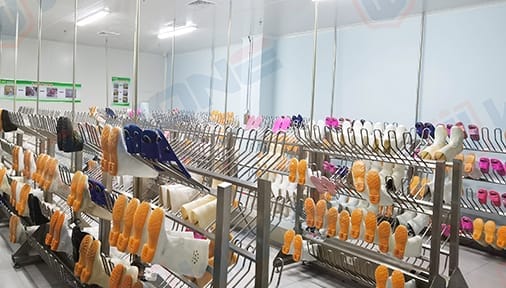
Whether the environment is wet or dry, keeping work boots dry and properly stored helps maintain an organized changing room and supports daily footwear management.
The right setup depends on the type and number of boots, the working schedule, and the available space.
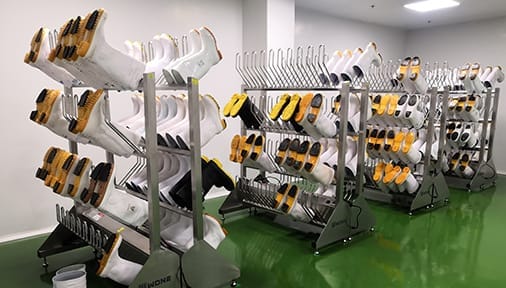
Below are some examples of boot drying equipment used in food processing environments.
Conclusion: Choose a Dryer That Fits the Whole Process
Choosing an industrial boot dryer for a food processing plant is not just about selecting a machine with enough drying positions.
The equipment needs to fit the shift schedule, the type of footwear, the available installation space, and the factory’s cleaning and storage procedures.
Start by identifying how many pairs need to be dried, how much time is available, and what level of drying performance is required. Then compare the machine’s capacity, controls, materials, energy requirements, and maintenance needs.
Most importantly, treat drying as one step in a wider footwear hygiene process.
When cleaning, any required disinfection, drying, and storage are planned together, it becomes easier to establish a consistent routine for employees and maintain an organized changing room.
Looking for an industrial boot dryer for your food processing plant? Explore WONE’s boot drying equipment or contact our team to discuss your capacity and installation requirements.