In food processing plants and other hygiene-sensitive facilities, changing room air disinfection can play an important role in controlling airborne contamination before employees enter production areas.
Changing rooms are a key transition point between the outside environment and controlled production areas. Employees may bring microorganisms, dust, and other contaminants into the facility through clothing, footwear, and personal contact. This is why proper ventilation, cleaning, personnel hygiene, and air treatment should be considered together as part of an effective hygiene strategy.
1. Why Is Air Hygiene Important in Changing Rooms?
Changing rooms and gowning areas can experience frequent personnel movement and relatively high occupancy during shift changes.
Employees may enter from:
- Outdoor areas
- Parking and transportation areas
- Staff facilities
- Toilets and welfare areas
- Raw-material or low-hygiene zones
Without appropriate hygiene controls, airborne particles and microorganisms can potentially be transferred toward higher-hygiene areas.
A well-designed personnel hygiene system should therefore consider several controls together:
Personnel flow → Changing/Gowning → Hand Hygiene → Footwear Hygiene → Air Hygiene → Controlled Production Area
Air disinfection should not be viewed as a replacement for ventilation, cleaning, or personnel hygiene. Instead, it can be used as an additional contamination-control measure where the risk assessment and facility requirements justify it.
2. What Do International Standards Say?
There is no single global regulation requiring every food-processing changing room to install an air disinfection machine.
Instead, international hygiene frameworks generally focus on controlling contamination through facility design, ventilation, cleaning, personnel hygiene, and operational procedures.
Codex General Principles of Food Hygiene
The Codex General Principles of Food Hygiene (CXC 1-1969) are widely used as an international reference for food hygiene management.
The guidance emphasizes hygienic facility design and appropriate ventilation. In particular, ventilation should prevent air from moving from contaminated areas toward clean areas.
This principle is particularly relevant to changing rooms and personnel entrances because these areas often form a transition between lower-hygiene and higher-hygiene environments.
ISO 14644 for Controlled Environments
For facilities requiring controlled environmental conditions, the ISO 14644 series provides internationally recognized principles for air cleanliness and contamination control.
ISO 14644-1 classifies air cleanliness according to airborne particle concentration, while ISO 14644-5:2025 addresses operational controls, including personnel management, gowning programs, cleaning, maintenance, and monitoring.
This is especially relevant to pharmaceutical, medical, biotechnology, and other controlled-environment applications, as well as food facilities where specific clean-area requirements apply.
The key point is that air disinfection should be selected according to the facility’s actual hygiene risk and environmental requirements, rather than simply installing equipment for compliance purposes.
3. How Can Air Disinfection Be Used in a Changing Room?
For changing rooms, the ideal solution should consider both:
Occupied periods — employees are entering, changing, and moving through the area.
Unoccupied periods — the facility can perform more intensive disinfection after personnel have left.
This is where a dual-mode air disinfection system can provide additional flexibility.
Mode 1: Air Disinfection During Occupied Periods
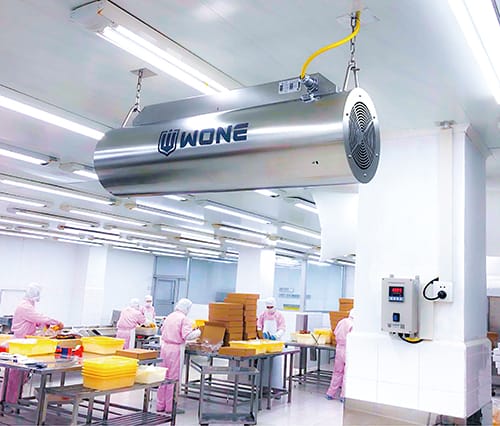
During working hours, an air disinfection unit can continuously circulate room air through an enclosed treatment chamber.
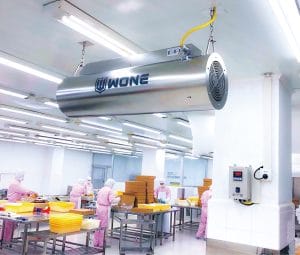
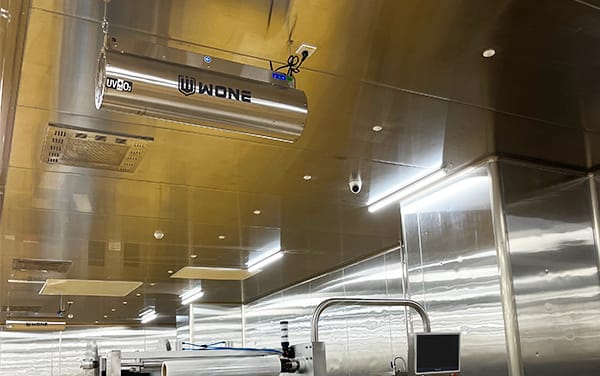
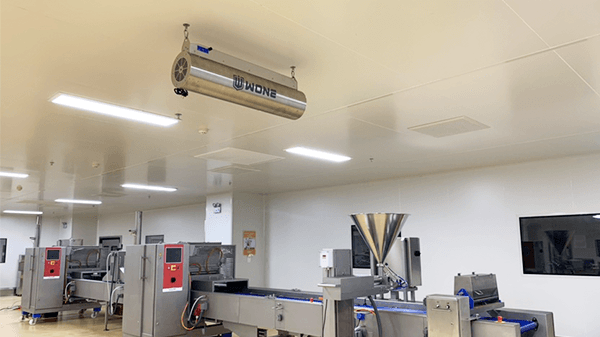
For example, WONE air disinfection systems use an internal fan to draw room air through the equipment, where UV-C treatment can be applied to microorganisms in the circulating air.
Because the UV-C source is enclosed inside the equipment, the treatment is designed to avoid direct UV exposure to occupants.
This approach allows air treatment to operate while personnel are present, provided that the equipment is properly designed, installed, operated, and maintained.
UV-C systems must be appropriately shielded because direct exposure to germicidal UV radiation can harm the eyes and skin. WHO guidance also emphasizes the importance of proper system design and protection against UV exposure.
Mode 2: Intensive Treatment During Unoccupied Periods
When the changing room is unoccupied, additional disinfection strategies may be considered according to the facility’s risk assessment and safety procedures.
Ozone is a strong oxidizing agent and can be used for controlled treatment of air and surfaces. However, ozone treatment must only be carried out under controlled, unoccupied conditions, with appropriate concentration control, ventilation, access control, and safety procedures.
The area should not be re-entered until ozone levels have been reduced to a safe level in accordance with applicable occupational and local requirements.
Therefore, ozone should never be presented as a simple “automatic safe after treatment” solution. Proper installation, monitoring, ventilation, and operating procedures are essential.
4. UV-C vs. Ozone: Which Is Better?
There is no single technology that is suitable for every changing room.
| Application | UV-C Air Treatment | Ozone Treatment |
|---|---|---|
| During personnel occupancy | Suitable when properly enclosed | Not suitable |
| Air circulation | Continuous treatment possible | Treatment normally performed during unoccupied periods |
| Odor control | Limited | Can help control certain odors |
| Access control | Less restrictive | Required |
| Safety requirements | UV shielding required | Strict exposure control required |
| Best application | Continuous air treatment | Periodic intensive treatment |
For many food-processing facilities, the most practical approach is to combine air treatment with other hygiene controls rather than relying on one technology alone.
5. What Can Air Disinfection Add to a Changing Room?
Reduce Airborne Contamination Risks
A properly selected air treatment system can help reduce the microbial load in recirculated air and support the overall contamination-control strategy.
This is particularly useful in personnel transition areas where employee movement is frequent.
Support a Cleaner Gowning Environment
Employees put on clean uniforms and protective clothing in changing rooms.
Maintaining a cleaner environment can help reduce the possibility of contaminants settling on freshly cleaned or sanitized workwear before employees enter production areas.
Help Control Unpleasant Odors
Changing rooms can accumulate odors due to footwear, clothing, perspiration, and high personnel density.
Some air treatment technologies, including ozone under controlled unoccupied conditions, can also support odor-control programs.
Strengthen the Hygiene Barrier
A changing room should be considered part of a broader personnel hygiene barrier.
The most effective approach combines:
Air control + Hand hygiene + Footwear hygiene + Protective clothing + Personnel flow control + Cleaning and sanitation
Together, these measures create a more robust transition between external and controlled production environments.
6. A Practical Air Hygiene Solution for Food Processing Facilities
WONE provides air disinfection solutions designed for hygiene-sensitive environments, including food processing facilities and other controlled areas.
Depending on the application, WONE systems can integrate technologies such as:
- Enclosed UV-C air treatment
- Controlled ozone treatment
- Air circulation
- Programmable operating modes
- Stainless steel construction
- Automatic operation
- Safety-oriented control systems
The exact configuration should be selected according to:
- Room size
- Personnel traffic
- Hygiene zoning
- Ventilation system
- Required air changes
- Operating schedule
- Microbiological risk
- Local regulations and customer specifications
This risk-based approach is more reliable than applying the same disinfection method to every changing room.
Conclusion: Air Hygiene Should Be Part of the Bigger Picture
So, does a changing room need air disinfection?
For ordinary changing rooms, there is no universal international rule requiring an air disinfection machine.
But for food processing plants, pharmaceutical facilities, cleanrooms, central kitchens, and other hygiene-sensitive environments, controlling airborne contamination in personnel transition areas can be an important part of an effective hygiene strategy.
The key is not simply to install an air disinfection device.
It is to build a complete hygiene barrier:
Clean personnel flow → Effective gowning → Hand hygiene → Footwear hygiene → Air hygiene → Controlled production
With the right combination of engineering controls, cleaning procedures, ventilation, personnel hygiene, and air treatment technology, facilities can create a cleaner and more controlled environment before employees enter critical production areas.
WONE provides professional personnel hygiene and air disinfection solutions to help food-processing facilities strengthen contamination control and build a more effective hygiene system.